Flight Delay Evidence Checklist: 5 Steps to Prepare Your Claim
Save booking records, arrival details, airline messages and receipts. Use this practical checklist to organise evidence without assuming a guaranteed payout.

Practical guidance expanded and reviewed September 17, 2026.
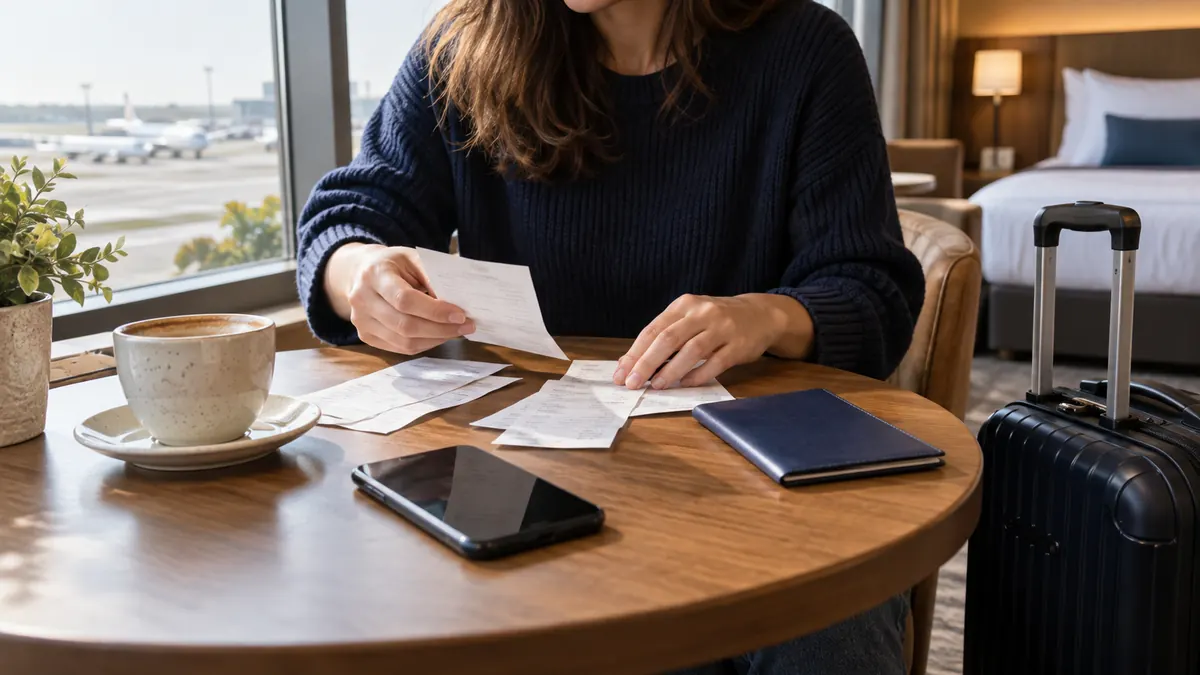
Illustrative AI-generated evidence-checking scene, not a real claimant or claim file. Sources checked September 8, 2026.
Quick answer: Save your booking, the disruption messages, your arrival record, assistance requests and receipts. A clear timeline helps a claim assessment; no photograph or checklist guarantees compensation.
Start with the facts while they are easy to recover. You do not need to photograph every minute of a delay, confront staff or collect other passengers' personal information. This checklist helps you assemble your own records, while the EU rights guide and UK261 guide explain eligibility.
Step 1: Save the booking and check-in record
Keep the original itinerary, ticket receipt, booking reference and boarding pass if available. Include each flight in a connecting booking and identify the operating airline. A boarding pass is useful, but it does not by itself prove every fact about attendance, boarding or arrival.
Download a copy while the airline app still shows it. If it is missing, ask for your booking and check-in confirmation; do not assume that losing one document automatically ends the claim. Keep the correspondence and explain any gap accurately.
Privacy check: Boarding-pass barcodes and booking references can expose travel details. Keep originals privately. Redact copies used in public posts, and send claim documents only through the airline's or your chosen representative's verified channel.
Missing a boarding pass, booking reference or airline message?
Identify the missing fact before searching for a substitute. Proof of payment, a reservation and actual travel are different things. The aim is a consistent record of your journey, not the largest possible attachment bundle.
| Missing item | Try these records | Explain the limit |
|---|---|---|
| Boarding pass | Airline account, saved wallet pass, check-in email, booking confirmation and a request for check-in or travel records. | A booking alone does not establish that you travelled. Explain whether you boarded, were refused boarding or had a cancelled flight. |
| Booking reference | Search the original email, agent account and ticket receipt using the route and date. Ask the seller for the airline reference and ticket details. | An agent's order number may differ from the airline reference. A bank entry can help locate a purchase but may not identify its passengers or sectors. |
| Written disruption reason | App notifications, SMS/email, complaint replies and a dated note of what staff said. | A note is your account, not an airline admission. Ask the carrier to confirm or correct the reason. |
| Actual arrival record | Saved airline status, your contemporaneous arrival note, onward transport records and a request for the carrier's recorded arrival time. | Explain what the time measures. Touchdown, gate arrival and being able to leave the aircraft are not interchangeable. |
| Itemised receipt | Ask the merchant for a duplicate invoice and retain the payment record. | A card transaction may show payment without what was purchased or who it covered. Never recreate a receipt or invent missing items. |
The CJEU's March 2025 explanation of Case C-20/24 confirms that a boarding pass may establish a confirmed reservation in the circumstances it considered. It does not make one document mandatory for every disruption, or make a bank statement a universal substitute. Describe your actual booking and travel circumstances.
If an online form will not continue without a reference, use the airline's verified customer-service or complaint route to request help identifying the booking. Do not enter a made-up reference, reuse another passenger's number or submit the same claim under several identities.
Do not wait indefinitely for a perfect file. Keep the relevant claim and complaint deadlines in view. A request for missing records does not itself pause every legal time limit. Explain outstanding documents and seek appropriate advice where a deadline is close.
Step 2: Record the timeline, including arrival
Save cancellation messages and significant status changes. A photograph of a departure board can support the departure timeline, but it does not establish the final arrival delay. Note the date, local time and location alongside your record, especially on an overnight or multi-time-zone itinerary.
At the destination, record when passengers could leave the aircraft and keep the final itinerary. Retain originals where possible. Phone timestamps can help, but screenshots do not automatically contain GPS information, and an email to yourself is not independent verification of every statement in it.
| Record | Useful for | Limitation |
|---|---|---|
| Original booking | Planned route, dates and connections. | Does not show actual travel. |
| Airline message | Notice timing, stated reason and offer. | May be revised or incomplete. |
| Arrival note | Your contemporaneous account of arrival. | May need corroboration if disputed. |
| Itemised receipt | What you bought, when and at what cost. | Does not prove the expense is recoverable. |
Step 3: Keep assistance requests and itemised receipts
Ask the airline what assistance is available and record its response before arranging your own alternative where practical. Keep the voucher, any refusal and receipts for meals, accommodation or necessary transport. Note who each purchase covered so a shared family expense is not counted multiple times.
For EU-covered disruption, Regulation 261/2004, Articles 6 and 9 sets the delay and care framework. Waiting time, flight distance and the type of disruption matter. Necessary, appropriate and reasonable expenses need a case-specific assessment; this guide does not promise a fixed meal allowance or reimbursement for every purchase.
Step 4: Ask for the reason and keep the response
A short, polite request is enough: “Please confirm the reason for the disruption to flight [number/date], the options offered and my complaint reference.” If staff cannot provide it at the gate, save the airline's messages and follow up through its official complaint channel.
Record the time and role of the person you spoke to if useful; you do not need to demand personal staff details. Distinguish a direct quotation from your own recollection. If the written reason later changes, ask the carrier to explain the difference. See how to assess an extraordinary-circumstances rejection.
Step 5: Report a separate baggage problem promptly
If a checked bag is missing or damaged, report it to the airline or handling desk and keep the Property Irregularity Report reference, baggage tag and delivery record. A PIR starts a tracing or incident record; it is not necessarily the written monetary claim.
Your Europe's baggage guidance distinguishes a written damage complaint within seven days from a delayed-baggage complaint within 21 days after receiving the bag. Do not use a blanket “seven days to file a delayed-bag PIR” rule. Check the applicable baggage process promptly, because it is separate from flight-delay compensation.
Keep additional losses separate
Save evidence of a missed prepaid booking or connection, but do not add it automatically to an EU fixed-compensation calculation. Contract terms, insurance and other legal rules may be relevant. Use the next-step guide to distinguish refunds, care, baggage and compensation.
An email to request missing flight records
Adapt this message and send it privately through the airline's or booking seller's verified channel. This is a practical records request, not a claim that every internal document must be disclosed.
Subject: Request for booking and disruption records: [flight/date]
I am trying to identify my booking for [passenger name, route and travel date]. My available reference is [airline reference, agent order number or ticket number, if known]. I am missing [specific record]. Please help me obtain the booking/check-in confirmation or other available record relevant to my journey.
Please also confirm the recorded disruption reason, the relevant arrival time and what that time represents, where available. I have attached [brief list of genuine supporting records]. Please advise if you need verification through a secure channel and provide a reference for this request.
Attach only relevant information. Do not email passwords, full payment-card details or unnecessary identity documents. A group booking does not authorise you to request another adult's private records without their permission. Keep your sent message and acknowledgement.
Keep a one-page checklist with your travel documents
The printable sheet covers booking, timeline, assistance, missing records and submission checks. It is a blank personal worksheet: no login, upload or FlyClaimer data collection is required. Store completed copies privately.
Download the evidence checklist (PDF)
One A4 page. You can print it or keep the PDF on your device. It helps organise facts; it does not establish eligibility or guarantee payment.
Missing evidence FAQ
Can I ask about compensation without my booking reference?
You can ask the airline or seller to locate your booking using genuine route, date, passenger and ticket details. Other evidence may help establish the journey, but a missing reference does not remove the need to show the relevant facts. Never invent a reference to pass an online form.
Is a bank statement enough to replace my boarding pass?
Not by itself in every case. It can support that a payment occurred, but may not show the passenger, flight, check-in or actual travel. Combine it with available booking or travel records and explain what remains missing.
Should I send FlyClaimer my documents?
No. FlyClaimer does not collect claim files through this guide. Keep your records privately and submit them only to the airline or a representative you choose through its verified channel. The optional AirHelp checker is a separate partner service.
Organise a file that someone else can follow
- Create a private folder named with the flight date and number.
- Keep originals and a readable copy of each important record.
- Write a short timeline with the time zone stated.
- Itemise the amounts requested and subtract refunds already received.
- Save the submitted form, attachments and complaint acknowledgement.
Back up the folder securely and retain it while the matter remains unresolved. There is no universal 60-day retention rule that fits every claim. Our claim follow-up guide explains how to keep track without unsupported payment deadlines.
The AirHelp checker is an optional partner service, not a FlyClaimer document-upload or legal-representation service. You can submit a claim directly to the airline.
Practical help when travel goes wrong
Was the schedule changed before travel?
Keep both versions of the itinerary. See what to do when an airline moves departure earlier for the notice and travel-choice questions.
Related travel tools
Optional partner links matched to this guide. FlyClaimer may earn a commission, but these links do not change our passenger-rights guidance.

We may earn a commission. Disclosure