
Airline Downgrade Refunds: EU, UK and US Rights Explained
Moved from business or premium economy into a lower cabin? Check the refund rules, the affected-flight calculation and the evidence to keep.
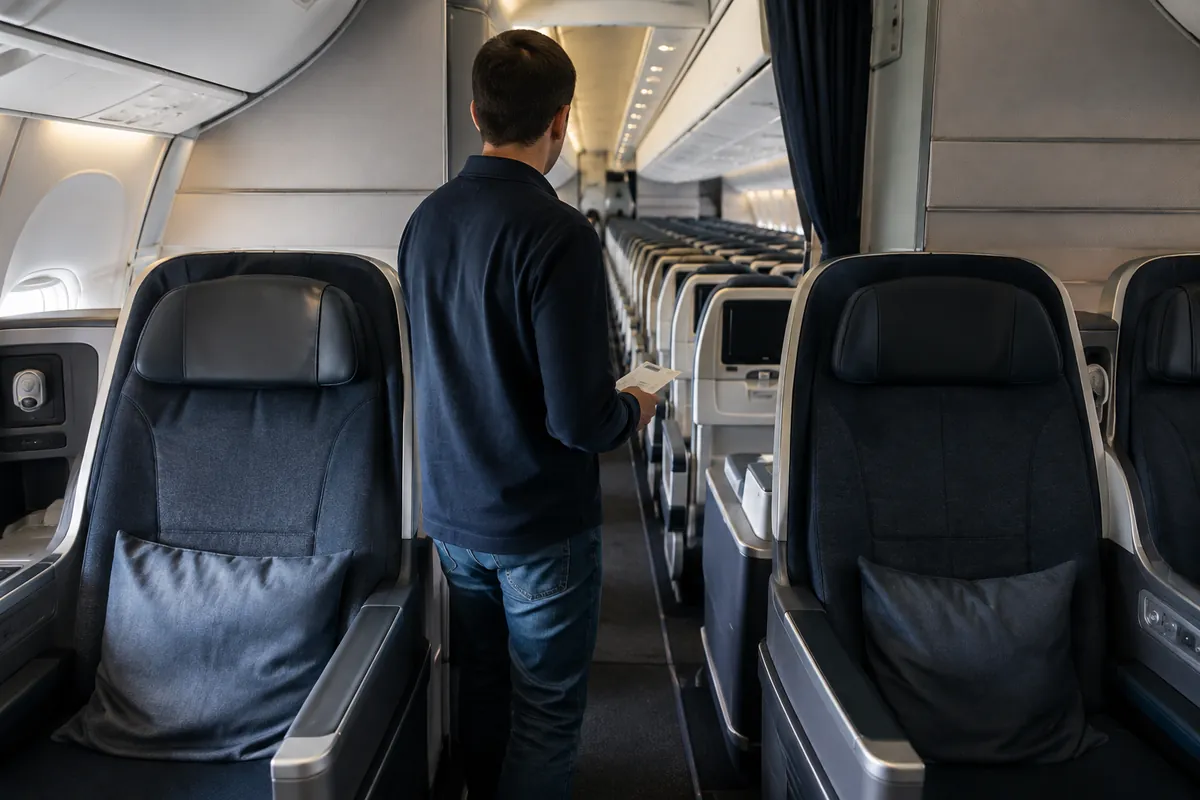
Practical checklist expanded and reviewed September 21, 2026.
Quick answer: If an airline moves you into a lower cabin, keep proof of both the class you bought and the class you actually flew. A covered EU or UK downgrade can mean a percentage reimbursement for the affected flight. US rules distinguish refusing the changed journey from flying in the lower cabin.
Reviewed September 6, 2026. The hero is an AI-generated editorial illustration, not a photograph of a reported incident.
What counts as an airline downgrade?
A cabin downgrade means being placed in a lower class than you purchased: for example, business to premium economy, or premium economy to economy. An aircraft change can cause it even if the flight leaves on time. Moving from a window to an aisle in the same cabin is a different problem; keep any seat-selection receipt and ask about the undelivered service instead.
Before accepting an offer, ask the gate agent to record whether the change is involuntary. If the airline offers another flight in your original cabin, ask when it arrives and what happens to your onward and return sectors. Do not cancel the whole booking yourself without understanding the consequences.
EU, UK and US downgrade rights compared
| Framework | If you fly in the lower cabin | What to check |
|---|---|---|
| EU261 | 30%, 50% or 75% reimbursement of the applicable affected-flight price. | Route coverage, distance band and the fare calculation. |
| UK261 | The CAA lists 30%, 50% or 75%, depending on distance. | Whether UK rules cover the flight and which sector was downgraded. |
| US DOT | A refund of the difference between the original fare and the downgraded fare. | Whether you travel or reject the changed itinerary. |
These are not interchangeable calculations. Start with our EU passenger-rights guide, UK261 guide or US passenger-rights guide for route coverage. The summary follows Your Europe, the UK CAA and US DOT refund guidance.
EU261: which percentage applies?
Under the current Article 10 rules, reimbursement is due within seven days for a covered involuntary downgrade. The percentage applies to the affected flight, not automatically to the entire holiday or return booking.
| Affected flight | Percentage |
|---|---|
| 1,500 km or less | 30% |
| Intra-EU flights above 1,500 km, except the French overseas-department exception; other flights above 1,500 km up to 3,500 km | 50% |
| Remaining flights, including the applicable flights between EU European territory and French overseas departments | 75% |
See Regulation 261/2004, Article 10. The reform approved in July 2026 has a later application timetable; an announcement is not a reason to apply future rules to a September 2026 flight.
Use the affected sector, not the cheapest new fare you can find
In Mennens v Emirates, C-255/15, the Court explained that the calculation uses the downgraded flight's price. Where that price is not shown separately, allocation is based on the affected flight's distance compared with the total ticketed distance. Taxes and charges are excluded where neither their payment nor their amount depends on cabin class.
Worked example, not a payout promise: If the correct reimbursement base for a covered long-haul sector is EUR1,200 and the 75% band applies, the calculation is EUR1,200 × 75% = EUR900. Do not multiply a EUR3,000 return ticket by 75% just because one outbound sector changed.
Ask the airline to show the sector allocation, excluded taxes and percentage. Keep that breakdown with your ticket. A voucher offer or a comparison with today's economy fare does not, by itself, explain an EU261 calculation.
What changes for UK and US flights?
UK flights
The CAA's downgrade table lists 30% for flights up to 1,500 km, 50% above 1,500 km up to 3,500 km, and 75% above 3,500 km. It explains that reimbursement generally relates to the downgraded portion. Coverage includes departures from the UK on any airline, arrivals in the UK on a UK or EU airline, and arrivals in the EU on a UK airline.
Flights to, from or within the United States
DOT treats an involuntary cabin downgrade as a significant change. If you decline to travel and do not accept an alternative such as a voucher, refund rights can apply. If you still fly in the lower cabin, DOT says the airline must refund the fare difference, not the full airfare. Use our US DOT refunds guide for timing and other significant-change rules.
On a transatlantic trip, more than one framework may be relevant. Explain which remedy you are requesting and disclose payments already received. Do not assume different systems can simply be added together for the same loss.
Check the airline's calculation before accepting it
A refund figure is easier to assess when you can see how it was built. Ask for the affected flight, the fare assigned to it, any excluded charges and the rule used. A goodwill voucher is not an itemised reimbursement calculation. Keep an offer and its settlement terms before choosing whether to accept it; our voucher-versus-cash guide explains that separate decision.
| Check | What to request | Warning sign to clarify |
|---|---|---|
| Affected sector | The flight number, date and original/actual cabins used in the calculation. | The reply treats the whole return journey as one unexplained amount. |
| Price basis | The ticketed sector price or an explanation of the allocation where it is not separately shown. | The only comparison is a fare advertised after your trip. |
| Taxes and charges | An itemised list and the reason each excluded amount is outside the reimbursement base. | Every charge is removed without explaining whether it depends on cabin class. |
| Payment already offered | What each payment or credit covers and whether anything remains outstanding. | A voucher, unused upgrade refund and downgrade reimbursement are combined without a breakdown. |
Illustrative allocation, not a quoted entitlement: Suppose an EU-covered downgraded sector is 4,000 km out of a 10,000 km ticketed journey, no separate sector price is shown, and the appropriate ticket-price base is EUR2,000 after the relevant charge assessment. The allocated base would be EUR2,000 × 4,000 / 10,000 = EUR800. If the 75% band applies, that gives EUR600. Change any assumption and the result can change.
The allocation principle comes from Mennens, C-255/15. This is an EU example, not a universal points-to-cash formula or the US fare-difference rule. Ask the airline to explain your actual ticket rather than presenting illustrative distances as facts.
Keep paid upgrades and reward-booking records separate
If you paid separately for an upgrade, retain both the original ticket and the upgrade receipt. If points or a companion voucher were involved, save the redemption confirmation, points debit, cash component and relevant booking terms. Do not substitute the current cash selling price for an award ticket without a supported basis.
Identify exactly what the airline has refunded. Returning an unused upgrade charge does not, by itself, explain whether another downgrade remedy was assessed; equally, two labels do not establish two payments for the same loss. Where valuation or overlapping remedies are disputed, request a reasoned response and use the appropriate dispute-resolution route rather than guessing a cash value.
Follow-up to adapt: Thank you for the offer for [flight/date]. Please identify the affected sector, fare basis, excluded charges and calculation used. Please also explain what [payment or credit already offered] covers. I have attached the original cabin confirmation, actual boarding pass and any separate upgrade receipt. I am asking for a breakdown, not accepting a settlement through this message.
Use the missing-document guidance if a receipt or boarding pass is unavailable. Keep personal records out of public comments and send them only through the airline's verified channel.
Your downgrade evidence checklist
- Original purchase: save the ticket receipt, cabin description, upgrade receipt and fare breakdown.
- Actual travel: keep the replacement boarding pass, flight number, date, route and seat details.
- Airline explanation: ask for written confirmation of the downgrade and why it happened.
- Your decision: record whether you flew, accepted a different flight, or requested a refund.
- Offer terms: save voucher restrictions and any settlement wording before accepting.
Use the airline's official complaint or refund channel. If a booking agent issued the ticket, request its fare breakdown too; our travel-agent refund guide explains how to trace the payment chain.
What to put in your request
Keep the request factual: identify the flight, the purchased and travelled cabins, whether you accepted the journey, and the reimbursement basis you believe applies. Attach the evidence and request an itemised calculation. If a separate delay or cancellation occurred, list that separately instead of labelling every amount as compensation.
Request outline: I purchased [cabin] on [flight/date/route] and was involuntarily moved to [cabin]. I [travelled / declined the changed journey]. Please assess my refund or downgrade reimbursement under the applicable rules and explain the fare basis, percentage or difference, and payment method. My ticket and boarding passes are attached.
Common downgrade questions
Does an on-time flight rule out reimbursement?
No. A lower cabin is a different issue from a late arrival. Focus your evidence on the class purchased and delivered.
Is a broken screen or a different seat a cabin downgrade?
Not necessarily. Identify the specific paid service that was missing and request the appropriate service-fee refund or contractual remedy. Do not assume a cabin-percentage award.
Can I also claim for denied boarding?
Being seated in a lower cabin is not the same as being refused carriage. If you were actually refused boarding, use our denied-boarding guide to check that separate event.
Where do I go if the airline rejects the claim?
Request a written final answer and the calculation. Then check the complaint route in the relevant country guide, including available dispute resolution. The correct route depends on the airline, journey and jurisdiction.
FlyClaimer provides information and referrals, not legal representation. A partner checker may not handle every downgrade-only dispute. You can contact the airline directly without using a paid intermediary.
Related travel tools
Optional partner links matched to this guide. FlyClaimer may earn a commission, but these links do not change our passenger-rights guidance.

We may earn a commission. Disclosure