Is the Jet Fuel Shortage an Extraordinary Circumstance Under EC 261? (2026 Legal Position)
Is the Jet Fuel Shortage an Extraordinary Circumstance Under EC 261?
Airlines are using “fuel shortage” as a blanket reason to deny compensation. The legal position is more nuanced — and more favourable to passengers — than they want you to think. Here is what the law actually says.
The Question Every Disrupted Passenger Is Asking
If your flight was cancelled or significantly delayed in 2026 and the airline cited “fuel shortage” or “fuel crisis,” you have likely already encountered a compensation rejection. Airlines have been issuing blanket denials, treating the current fuel crisis the same way they treated COVID-19 — as a universal shield against paying any EC 261 compensation at all.
The legal position is more complicated than that — and critically, it is more favourable to passengers than airlines are suggesting.
The EU Transport Commissioner confirmed in April 2026 that cancellations due to high fuel prices do not automatically qualify as extraordinary circumstances. There is a meaningful legal distinction between a fuel shortage and a fuel price increase — and it directly affects your right to compensation.
What EC 261 Actually Says About Extraordinary Circumstances
An operating air carrier shall not be obligated to pay compensation… if it can prove that the cancellation is caused by extraordinary circumstances which could not have been avoided even if all reasonable measures had been taken.
This single paragraph is where every disputed compensation claim ultimately lands. Notice three things the regulation requires the airline to demonstrate — not just assert:
The circumstance was extraordinary
Meaning it was outside the normal activity of the airline and outside its actual control — not merely inconvenient, expensive, or commercially undesirable.
It could not have been avoided
Even if the circumstance itself qualifies, the airline must show it took all reasonable measures and still could not avoid the cancellation. Airlines with better fuel hedging, reserves, or contingency planning may not meet this test.
The burden of proof rests with the airline
The passenger does not need to disprove extraordinary circumstances. The airline must prove them — in writing, with specific evidence about this specific flight. A generic rejection letter referencing “the fuel crisis” does not meet this standard.
The 2026 Fuel Crisis: What Has Actually Been Confirmed
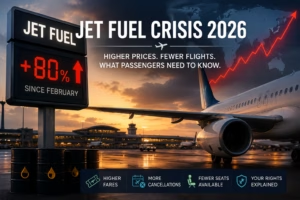
The current crisis stems from the closure of the Strait of Hormuz following the outbreak of armed conflict involving Iran in late February 2026. The Strait is a critical global energy corridor through which approximately 20% of global oil and a significant share of European jet fuel passes. Europe imports around 40% of its aviation fuel through this route.
This is an undeniably external, geopolitical event — the kind of event that EC 261 and legal precedent typically characterise as extraordinary. However, the EU Transport Commissioner introduced an important nuance in April 2026 that complicates the airline position substantially:
“In the event of a cancellation or significant delay, passengers have the right to clear information, assistance, and care, as well as reimbursement or rerouting. We believe that flight cancellations due to high prices do not necessarily qualify as extraordinary circumstances.”
— EU Transport Commissioner Tzitzikostas, April 2026
The Commissioner drew a precise legal distinction. The fuel crisis has two distinct components — and they do not both produce the same compensation outcome:
The Shortage vs. Price Distinction — Why It Matters
| Scenario | Likely EC 261 status | Compensation |
|---|---|---|
| Physical fuel unavailability — the airline genuinely cannot obtain enough jet fuel to operate the flight regardless of price | Likely extraordinary circumstance — geopolitical event outside airline control | Likely blocked |
| Fuel too expensive — airline cancels because fuel costs make the route commercially unviable | Likely NOT extraordinary — airlines expected to manage fuel price risk through hedging and reserves | May still apply |
| Vague “operational reasons” — airline provides no specific fuel-related explanation | Burden of proof has not been discharged by airline | Contestable — submit claim |
| Route cancelled 14+ days in advance — proactive summer schedule cut | EC 261 cash compensation not owed regardless of reason | Not applicable (refund still owed) |
How This Compares to COVID-19
The COVID-19 pandemic set the most recent major precedent for extraordinary circumstances claims. Understanding the comparison helps clarify where the fuel crisis is legally similar — and importantly, where it differs.
🦠 COVID-19 (2020–2022)
- Government travel bans made flights legally impossible
- Airports and countries physically closed
- No airline could operate regardless of cost or intent
- Clear force majeure across entire industry simultaneously
- Compensation broadly blocked — but refund rights remained
⛽ Jet Fuel Crisis (2026)
- No government flight bans — airlines choosing to cut routes
- Many routes still operating on same airlines
- Cancellations driven by cost as much as physical shortage
- Airlines with better hedging less affected than others
- Compensation status depends on why your specific flight was cut
The COVID comparison actually works against airlines in the current crisis. In 2020, governments made flights impossible by law. In 2026, no such legal impossibility exists. Airlines are making operational and commercial choices — and choices are subject to a higher standard of scrutiny under EC 261 than genuine force majeure events.
Legal Decision Tool — Does Extraordinary Circumstances Apply to Your Case?
Work through the legal test step by step — the same analysis an airline should be applying to your claim.
What the January 2026 Court Ruling Adds
Separately from the fuel crisis, a General Court judgment issued in January 2026 made an important contribution to how extraordinary circumstances are interpreted. The ruling confirmed that air traffic management decisions imposed by external authorities — not by the airline — can constitute extraordinary circumstances, while clarifying that not all ATC-related issues automatically qualify.
The significance for the fuel crisis: the ruling reinforces that the extraordinary circumstances test requires a case-by-case analysis based on the specific cause of the specific disruption. Blanket industry-wide rejections citing “the fuel crisis” without case-specific analysis do not satisfy the legal standard. Each cancellation must be evaluated on its own facts.
Practical Implications: What This Means for Your Claim
The legal picture in April 2026 produces these practical conclusions for passengers:
- Always submit the claim. Even if you suspect the airline will argue extraordinary circumstances, submit your EC 261 compensation claim. The airline must then prove their position in writing — and many cannot or will not do so to the required standard.
- Ask for the specific reason in writing. “Fuel shortage” covers two very different legal situations. Ask the airline to confirm in writing whether the flight was cancelled due to physical fuel unavailability or due to fuel cost pressures.
- Your refund right is absolute. Regardless of any extraordinary circumstances argument, you are entitled to a full cash refund. Vouchers offered in place of refunds require your explicit consent.
- Care rights are unconditional. Meals, accommodation if stranded overnight, and transport to and from the hotel must be provided regardless of the cancellation cause. Keep all receipts.
- Early cancellations (14+ days) block compensation — not refunds. Many airlines are proactively cutting summer routes. If they gave you 14 days or more notice, compensation is not owed — but refund and rebooking rights remain fully intact.
Frequently Asked Questions
Need Your Specific Case Assessed?
FlyClaimer analyses your claim against EC 261, UK261 and ECAA rules — including the extraordinary circumstances test for fuel-related cancellations. Free eligibility check, no upfront cost.
No win, no fee · EU, UK and ECAA routes · Takes under 2 minutes