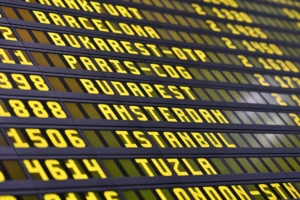
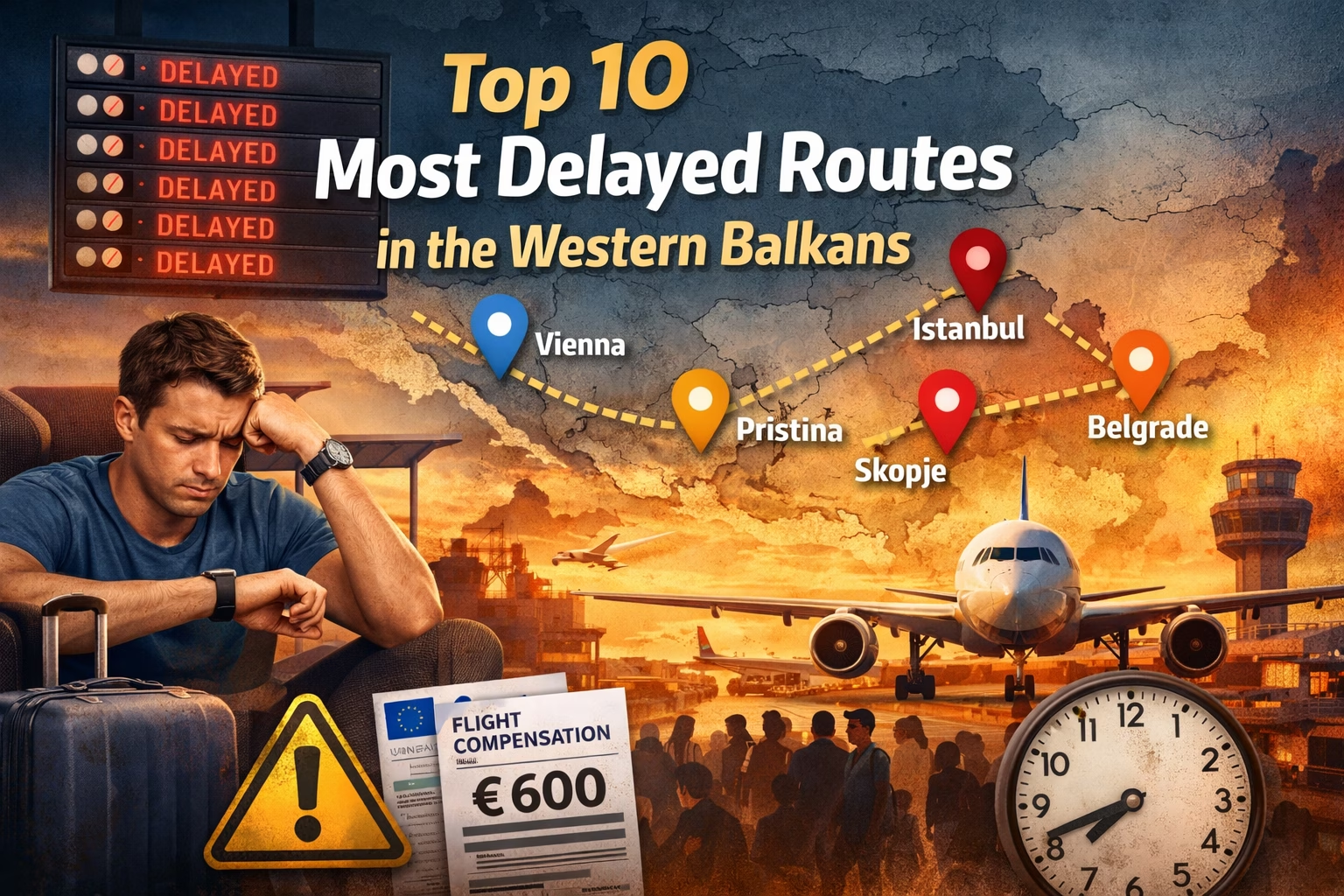
Top 10 Most Delayed Routes in the Western Balkans
FlyClaimer Travel Insights
Top 10 Most Delayed Routes in the Western Balkans
Flight delays are part of life across Europe, but some routes in the Western Balkans seem to test passengers more than others.
The pattern is not random. Heavy summer demand, tight aircraft rotations, busy connection hubs, weather disruption, and air traffic
control pressure all combine to make certain city pairs much more delay-prone than average.
In this FlyClaimer editorial ranking, we look at ten routes that are often among the most vulnerable to disruption in the
Western Balkans travel corridor. This is not just about how many people fly them. It is also about how exposed those flights are
to knock-on delays from larger European hubs, high-frequency scheduling, and seasonal congestion.
Important: If your flight arrived 3+ hours late, was cancelled at short notice, or you were denied boarding,
you could be entitled to up to €600 in compensation under EU261 or the UK equivalent rules, depending on the route and airline.
How We Built This Ranking
Because there is no single public league table covering every delayed route in the Western Balkans, this list is based on a practical mix of:
- high-traffic routes from the region’s busiest airports,
- connections into delay-sensitive European mega-hubs,
- routes with strong summer peaks and tight turnarounds,
- airport and ATC pressure that regularly creates reactionary delays.
In simple terms: these are the routes that combine busy demand with high operational stress.
Top 10 Most Delay-Prone Routes in the Western Balkans
| # | Route | Why it gets delayed |
|---|---|---|
| 1 | Belgrade – Istanbul | Very high frequency, hub congestion, heavy onward-connection pressure, and constant network dependency. |
| 2 | Pristina – Basel | Extremely strong diaspora demand, busy peaks, and tight low-cost scheduling. |
| 3 | Belgrade – Vienna | Short-haul business route with dense schedules and strong exposure to delays in Central Europe. |
| 4 | Skopje – Istanbul | Heavy reliance on a major transfer hub makes this route vulnerable to rolling disruptions. |
| 5 | Pristina – Zurich | High passenger loads, strong family-travel seasonality, and pressure around Swiss hub operations. |
| 6 | Sarajevo – Istanbul | Hub-bank timing, weather sensitivity, and rising passenger volume all raise delay risk. |
| 7 | Belgrade – Frankfurt | One of the classic delay magnets due to congestion at one of Europe’s busiest business hubs. |
| 8 | Podgorica – Belgrade | High regional dependence, frequent operations, and spillover delays during summer and holiday peaks. |
| 9 | Tirana – Milan | Dense demand, fast turnarounds, and recurring pressure on Italy’s northern airport system. |
| 10 | Skopje – Basel | A classic diaspora corridor where strong demand and low-cost operating models can amplify disruption. |
1. Belgrade – Istanbul
If one route deserves to sit at the top, it is this one. Belgrade is the region’s largest airport market, and Istanbul is one of the
most important aviation hubs in Europe and beyond. That combination creates a perfect storm for delays.
Flights on this route are exposed to multiple pressure points at once: busy departure waves, connecting passenger banks, long aircraft
rotations, and congestion from one of the most operationally intense airport systems in the region. Even a minor delay early in the day
can quickly snowball.
2. Pristina – Basel
Basel is one of the strongest diaspora-linked routes from Kosovo, and that matters. Routes with highly concentrated passenger demand,
especially around weekends, holidays, and summer peaks, often run with little room for recovery. Once an aircraft arrives late, the
next leg can easily depart late too.
For passengers, that means a route that may look simple on paper can become frustratingly unreliable during high-demand periods.
3. Belgrade – Vienna
Vienna is a key business and transfer market, which makes this corridor busy, strategically important, and delay-sensitive. Short-haul
business routes often operate on tight timings. That can be efficient when everything runs on schedule, but less forgiving when aircraft,
crews, or inbound flights slip.
Because Vienna connects so strongly into the wider European network, disruption elsewhere can feed directly into this route.
4. Skopje – Istanbul
Like Belgrade–Istanbul, this route depends heavily on the flow of a major hub. Passengers are not just flying point to point. Many are
connecting onward, and that creates scheduling pressure that can make recovery harder when delays begin.
Hub routes often look resilient because they are frequent, but in reality they can be vulnerable because the whole system is so tightly linked.
5. Pristina – Zurich
Zurich is another major diaspora and connectivity route from Kosovo. High loads are normal, and strong seasonal spikes add more stress.
Routes like this are especially exposed during school holidays, long weekends, and summer departure waves.
From a passenger rights perspective, this is exactly the kind of route where a long delay can quickly turn from “annoying” into compensable.
6. Sarajevo – Istanbul
Sarajevo has grown strongly in recent years, and Istanbul remains one of its most important international links. Growth is good news for
connectivity, but it also means more pressure on airport handling, departure sequencing, and recovery margins.
Add weather variability and network congestion, and this route can become one to watch closely during busy seasons.
7. Belgrade – Frankfurt
Frankfurt is famous for connectivity, but also for being a route where even small network issues can become larger delay events.
Flights touching large business hubs often absorb disruption from many directions at once: runway pressure, missed slots, inbound delay,
and airline rotation issues.
For passengers, this means that a short direct route can still face long arrival delays simply because the wider system is under strain.
8. Podgorica – Belgrade
Some of the most delay-prone routes are not the longest or most international. They are the regional lifelines that operate frequently
and serve a wide mix of local, business, and connection traffic. Podgorica–Belgrade fits that profile.
In summer especially, the route can pick up pressure from broader network disruption, late inbound aircraft, and dense day-of-operation scheduling.
9. Tirana – Milan
Tirana has become one of the most dynamic airport markets in the wider region, and Italy routes remain among the busiest. Milan is a classic
example of a route that mixes strong local demand, migrant and family traffic, tourism, and tight airline scheduling.
Short sectors with fast turnarounds are efficient when operations are smooth, but when the schedule gets compressed, delays can spread quickly.
10. Skopje – Basel
This route closes the list for many of the same reasons as Pristina–Basel: strong diaspora demand, busy seasonal peaks, and airline models
that often rely on efficient aircraft utilisation. That creates value for travellers, but it can also reduce operational slack.
When a delay starts earlier in the aircraft’s daily rotation, the impact can easily reach this route by departure time.
Why These Routes Get Delayed So Often
Across the Western Balkans, delays usually come from the same core set of causes:
- Air traffic control restrictions during peak European traffic periods,
- busy hub dependence on airports like Istanbul, Vienna, Frankfurt, and Zurich,
- tight aircraft rotations with little room to recover lost time,
- summer demand spikes driven by tourism and diaspora travel,
- weather and airport handling bottlenecks that create knock-on disruption.
Delayed in the Western Balkans? You May Be Owed Compensation
If your flight departed from the EU, arrived in the EU on an EU/EEA/UK airline, or otherwise fell under EU passenger rights rules,
you may be eligible for compensation when the delay reached 3 hours or more at arrival.
- Up to €250 for shorter flights
- Up to €400 for many medium-haul routes
- Up to €600 for longer eligible flights
Compensation depends on the route, airline, delay length, and whether the disruption was caused by extraordinary circumstances.
What Passengers Should Do After a Delay
- Keep your boarding pass and booking confirmation.
- Take screenshots of departure and arrival times.
- Ask the airline for the reason for the delay.
- Keep receipts for food, drinks, hotel stays, or transport if needed.
- Check whether your route qualifies under EU261.
Final Thoughts
The most delayed routes in the Western Balkans are usually not random one-offs. They are busy, strategically important corridors where
demand is high and operational pressure is constant. Hub links such as Istanbul, Vienna, Frankfurt, and Zurich remain especially vulnerable,
while diaspora-heavy city pairs can become delay hotspots during peak travel periods.
For travellers, the lesson is simple: if your route is one of the region’s busiest and your arrival was significantly late, do not assume
that “this is just normal.” In many cases, you may have a valid compensation claim.
FAQ
Which airport in the Western Balkans sees the most delay pressure?
Belgrade is usually the strongest candidate because of its scale, route density, and dependence on major European connections.
But delay pressure also builds quickly on routes involving Istanbul, Zurich, Vienna, and Frankfurt.
Are short regional flights covered by EU261?
Yes, many short-haul flights are covered. The amount depends on distance, airline, and where the flight departed from or arrived
Do bad weather delays qualify for compensation?
Usually not. Severe weather is often treated as an extraordinary circumstance. But many delays blamed on “operational issues” may still qualify.
Can I claim for a delayed flight from Tirana, Pristina, Skopje, or Sarajevo?
Sometimes yes, sometimes no. Eligibility depends on the exact route, the operating airline, and whether EU or equivalent passenger-rights rules apply to your journey.