
Is Crew Sickness an Extraordinary Circumstance? 2026 Passenger Guide
Crew sickness is often not enough by itself to reject compensation. Airlines still need to explain staffing, standby crew, reasonable measures and the exact delay cause.
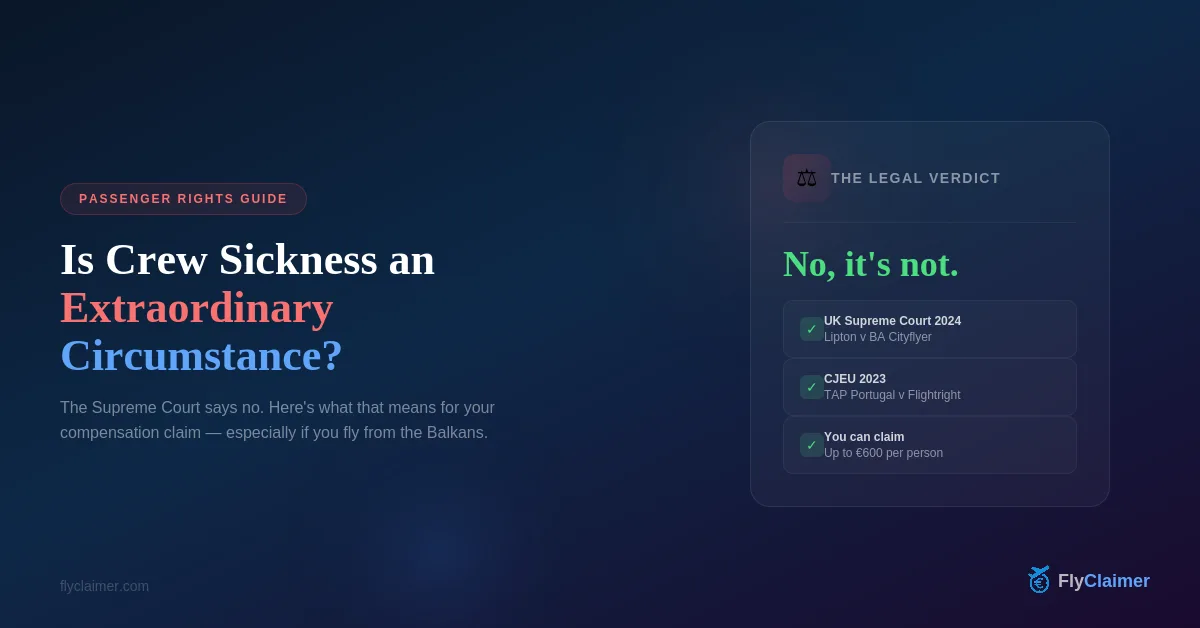
Crew sickness is not an automatic extraordinary circumstance
Airlines still need to show why the sickness could not be managed with standby crew, roster planning or reasonable operational measures. The exact facts matter, especially for cancellations and long arrival delays.
Your flight from Tirana was cancelled. The gate agent blamed a "sick pilot." The airline says tough luck — extraordinary circumstances, no compensation. You pack your bags, accept a rebooking, and move on.
Except you shouldn't. Because crew sickness is ot an extraordinary circumstance. And you are very likely owed compensation.
This is one of the most misunderstood areas of EU flight compensation law — and one of the most common reasons airlines give when rejecting valid claims. If you've been told your delay or cancellation was caused by crew sickness and that you're not entitled to anything, keep reading. The law is firmly on your side.
What Are Extraordinary Circumstances Under EC 261?
EU Regulation 261/2004 entitles passengers to fixed compensation — between €250 and €600 per person — when a flight is delayed by 3 or more hours, cancelled at short notice, or when passengers are denied boarding. Airlines are required to pay this regardless of ticket price, fare class, or how you booked.
There is one key exception. Airlines are exempt from paying compensation if they can prove the disruption was caused by extraordinary circumstances — events genuinely beyond the airline's control that could not have been avoided even if all reasonable measures had been taken.
The regulation itself does not give an exhaustive list of what qualifies. But through years of court rulings across Europe and the UK, a fairly clear picture has emerged.
Events that typically qualify as extraordinary circumstances:
- Severe weather that makes flying unsafe — hurricanes, heavy snow, volcanic ash, thick fog
- Air traffic control strikes or airspace restrictions imposed by authorities
- Security threats such as bomb scares, political unrest, or terrorist attacks
- Airport closures ordered by authorities
- Bird strikes causing significant damage to the aircraft
- Medical emergencies on board during a flight
Events that are ot extraordinary circumstances:
- Technical faults and routine maintenance issues
- Crew sickness or staff shortages
- Airline staff strikes (pilots, cabin crew)
- Internal scheduling and operational failures
- Issues resulting from the airline's own management decisions
The distinction is straightforward: if the event is inherent to the airline's operations — something the airline should reasonably plan for — it's not extraordinary. And crew sickness falls squarely into that category.
Why Crew Sickness Is Not Extraordinary
People get sick. That's not extraordinary — it's one of the most predictable realities of employing human beings. Every business with employees deals with staff calling in sick. Airlines are no different.
The logic behind the legal position is simple. Airlines employ hundreds or thousands of crew members. They know, with certainty, that some percentage of them will fall ill on any given day. Managing that reality — through standby crew rosters, backup scheduling systems, and contingency planning — is a basic operational responsibility.
When an airline cancels or delays a flight because a pilot or cabin crew member is unwell and no replacement is available, that's a failure of their contingency planning. It's not an external shock that nobody could have anticipated.
This is the same reasoning courts have applied to technical faults. Aircraft components wear out. Mechanical issues happen. Airlines are expected to maintain their fleet and have systems in place when things go wrong. Staff illness is no different — it's inherent to running an airline.
The Landmark Case: Lipton v BA Cityflyer (2024)
The question of crew sickness and extraordinary circumstances was settled decisively by the UK Supreme Court in July 2024 in the case of Lipton v BA Cityflyer Ltd [2024] UKSC 24.
Here's what happened. In January 2018, Mr and Mrs Lipton were booked on a BA Cityflyer flight from Milan to London City Airport. About an hour before departure, the captain reported an unspecified illness. No replacement pilot could be found, and the flight was cancelled. The Liptons were rebooked and arrived approximately 2.5 hours later than planned. They each claimed €250 in compensation under EC 261.
BA Cityflyer refused. Their defence: the pilot's illness was an extraordinary circumstance outside the airline's control.
The case worked its way through every level of the UK judiciary — Portsmouth County Court, Winchester County Court, the Court of Appeal, and finally the Supreme Court. That's ten judges across six years, all examining the same question.
The Supreme Court ruled unanimously in favour of the Liptons. The key finding: crew sickness is inherent to the airline's operations and does not constitute an extraordinary circumstance.
The Court drew a direct parallel with technical faults. Just as mechanical wear and tear is an expected part of operating aircraft, staff absence due to illness is an expected part of employing people. The fact that the illness occurred while the pilot was off-duty made no difference — managing crew availability, including unexpected absences, is part of the airline's core operational responsibility.
The Court was also clear about the purpose of EC 261: to provide consumers with a high level of protection. Any exception to that protection must be interpreted strictly and viewed from the passenger's perspective, not the airline's.
As the Supreme Court itself acknowledged, although the sum at stake for the Liptons was small, the decision had the potential to affect tens of thousands of claims made annually.
The EU Position: TAP Portugal and the CJEU
The UK Supreme Court's ruling aligned closely with the position of the Court of Justice of the European Union (CJEU).
In the 2023 case of TAP Portugal v Flightright GmbH, the CJEU examined an even more extreme scenario: a flight was cancelled after the entire crew declared itself unfit to fly following the sudden death of the co-pilot during a layover. TAP Portugal argued this was clearly extraordinary.
The CJEU disagreed. It ruled that managing unexpected staff absence — whether caused by illness, or even death — is intrinsically linked to crew planning and staff management, and therefore inherent to the carrier's activities.
If the sudden death of a crew member doesn't qualify as extraordinary circumstances, routine crew sickness certainly doesn't.
This means the legal position is now consistent across both the UK and the EU: crew sickness is not an extraordinary circumstance, and airlines cannot use it to avoid paying compensation.
What This Means for Passengers Flying from the Balkans
If you're flying from Tirana, Belgrade, Pristina, Skopje, Podgorica, or Sarajevo, this matters directly to you.
The Western Balkans are part of the European Common Aviation Area (ECAA), which aligns passenger protections closely with EU standards. Airlines operating from Balkan airports — including Wizz Air, Ryanair, and other carriers — are subject to these rules.
That means if your Wizz Air flight from Tirana was cancelled because a crew member was sick, you are entitled to compensation. If your Ryanair departure from Skopje was delayed four hours because the airline couldn't find a replacement pilot, you have a valid claim.
The compensation amounts are the same regardless of what you paid for your ticket:
| Flight distance | Compensation |
|---|---|
| Up to 1,500 km | €250 per person |
| 1,500 – 3,500 km | €400 per person |
| Over 3,500 km | €600 per person |
A family of four on a single disrupted flight could be owed up to €2,400. For a route like Tirana to Milan (approximately 1,062 km), each passenger would be entitled to €250.
What Airlines Will Tell You (And Why It's Wrong)
Airlines know that most passengers don't understand the legal position. When they reject a claim citing "crew sickness" as an extraordinary circumstance, they're counting on you accepting it and moving on.
Here are the most common lines airlines use — and why they don't hold up:
"The illness was sudden and unforeseen."
Irrelevant. Individual instances of illness are always unforeseeable. But the fact that crew members will sometimes fall ill is entirely foreseeable, and airlines are expected to plan accordingly.
"We had no available replacement crew."
That's a failure of the airline's own contingency planning — not an extraordinary circumstance. Airlines are expected to maintain standby crew, particularly at their operational bases.
"A court ruled that crew sickness is extraordinary."
Some airlines still reference early lower-court rulings that went in their favour. These have been comprehensively overturned. The UK Supreme Court and the CJEU have both confirmed that crew sickness is not extraordinary. Any airline still citing outdated rulings is being deliberately misleading.
"This falls under our force majeure policy."
EC 261 does not use the term "force majeure." The relevant test is "extraordinary circumstances" as defined by the regulation and interpreted by the courts. Airlines do not get to define the threshold themselves.
What About a Passenger Getting Sick on Board?
There's an important distinction here. If a passenger suffers a medical emergency during a flight — forcing the plane to divert to the nearest airport — that can qualify as an extraordinary circumstance. An in-flight medical emergency is genuinely external to the airline's operations and not something the airline could have predicted or prevented.
But crew sickness before departure is fundamentally different. The crew member's attendance or absence is part of the airline's operational planning, not an external event that happens during the flight.
How to Claim If Your Flight Was Disrupted by Crew Sickness
If your flight was delayed by 3+ hours or cancelled due to crew sickness, here's what you should do:
1. Get the reason in writing
Ask the airline for written confirmation that the disruption was caused by crew sickness or a staffing issue. Keep any text messages, emails, or airport announcements. If you can, take a photo of the departure board showing the delay or cancellation.
2. Keep all documents
Hold on to your boarding pass, booking confirmation, and any receipts for food, transport, or accommodation you had to pay for because of the disruption.
3. Check your eligibility
Use FlyClaimer's free eligibility checker to confirm your flight qualifies. You'll need your flight number, date, and departure airport. It takes under 60 seconds.
4. File your claim
You can file directly with the airline using our step-by-step guide, or connect with a vetted no-win-no-fee claims partner who handles the process for you.
5. Don't accept a rejection
If the airline tells you crew sickness is an extraordinary circumstance, push back. The law is on your side. Reference the Supreme Court ruling in Lipton v BA Cityflyer [2024] UKSC 24 and the CJEU ruling in TAP Portugal v Flightright GmbH (2023).
The Bottom Line
Crew sickness is ot an extraordinary circumstance. This isn't a grey area or an open legal question — it's been confirmed at the highest courts in both the UK and the EU.
Airlines are responsible for managing their staff, including planning for illness. When they fail to do that and your flight is disrupted as a result, you are entitled to compensation of up to €600 per person under EC 261/2004 and equivalent ECAA rules.
If your flight from any Western Balkan airport — Tirana, Belgrade, Pristina, Skopje, Podgorica, Sarajevo — was delayed or cancelled because of crew sickness, don't accept the airline's excuse. Check your eligibility and claim what you're owed.
Related travel tools
Optional partner links matched to this guide. FlyClaimer may earn a commission, but these links do not change our passenger-rights guidance.
AirHelp
Passenger-rights claim service for travelers checking whether a delayed, cancelled, overbooked, or missed-connection flight may qualify for compensation.
Aviasales
Flight search option for travelers comparing replacement flights or new travel plans after a disruption.
Yesim
eSIM option for travelers who need mobile data before, during, or after an international trip.
Affiliate link: we may earn a commission at no extra cost to you. Affiliate disclosure