
US DOT Automatic Refund Rules
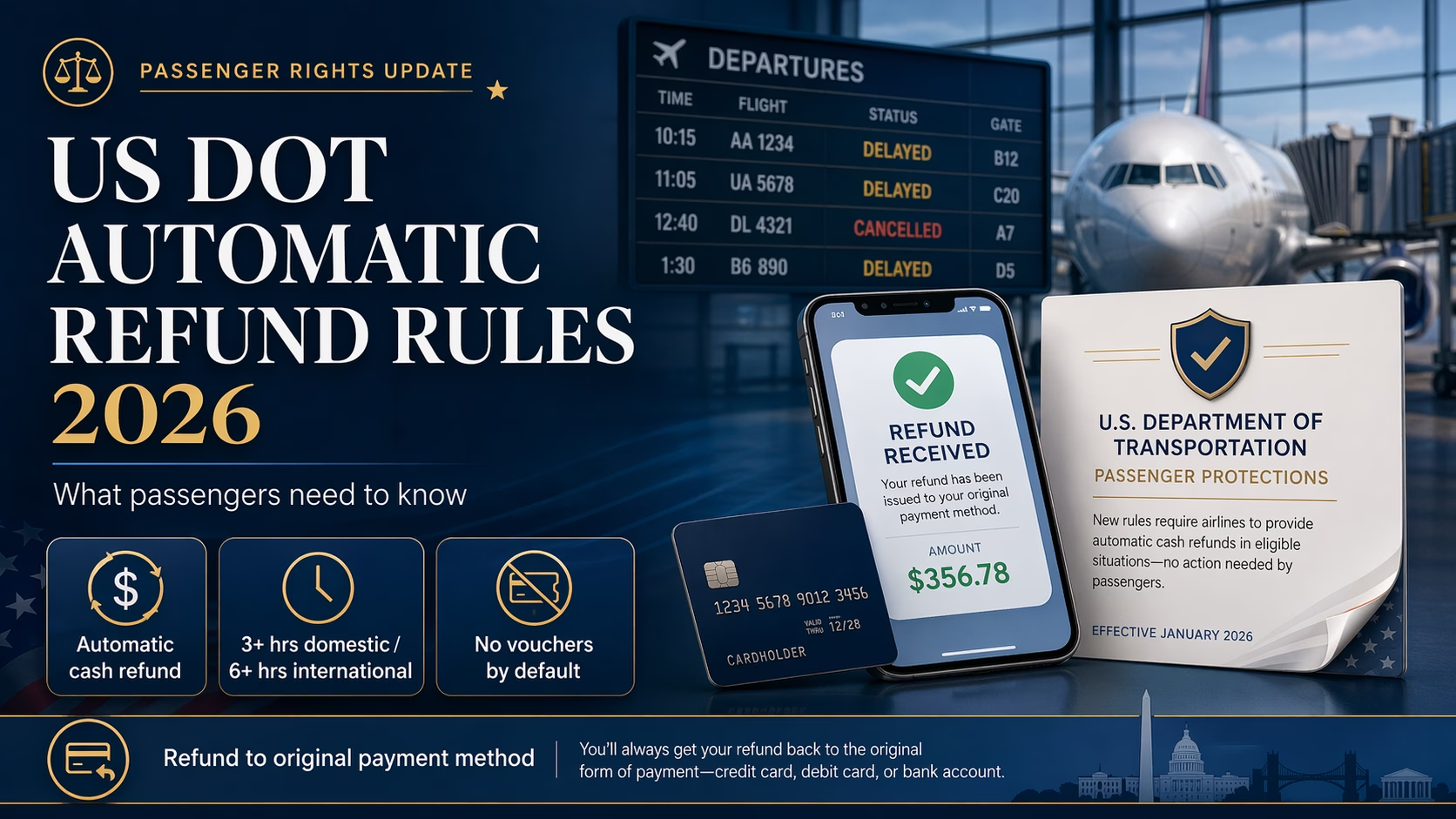
US DOT Automatic Refund Rules 2026: Your Complete Guide
If your flight in the United States is cancelled or significantly delayed, you are now legally entitled to an automatic cash refund — no forms, no calls, no vouchers. The U.S. Department of Transportation’s Final Rule on Automatic Refunds is fully in effect as of 2026, and it changes the game for American air travelers.
Here is exactly what the rule requires, when it applies, and how it compares to protections in Europe and beyond.
What the DOT Automatic Refund Rule Requires
The rule is straightforward. Airlines operating in the United States must automatically issue refunds when any of the following occur:
Your flight is cancelled and you choose not to accept the airline’s rebooking offer. This applies regardless of the reason for the cancellation — weather, mechanical issues, staffing, or the current jet fuel crisis.
Your flight is significantly delayed. The DOT defines “significant” as 3 or more hours for domestic flights and 6 or more hours for international flights.
The airline makes a significant change to your itinerary. This includes major time changes, airport changes, or the addition of extra connections that were not part of your original booking.
Your checked bag is significantly delayed. If your bag does not arrive within 12 hours on a domestic flight or 15–30 hours on an international flight, you are entitled to a refund of your checked bag fee.
The Key Change: No More Vouchers
Before this rule, airlines routinely offered travel credits or vouchers instead of cash when flights were disrupted. Many passengers accepted them — either because they did not know they had a right to cash, or because the airline made it the default option.
That is no longer legal. Under the new DOT rule, airlines cannot substitute vouchers or travel credits for a cash refund unless you, the passenger, explicitly choose to accept them. The refund must be automatic — the airline is required to initiate it without you having to ask.
This is a significant shift. For years, the burden was on passengers to request refunds, navigate phone queues, and fight for their money. Now, the obligation sits squarely with the airline.
What the US Rule Does NOT Cover
It is important to understand the boundaries. The DOT rule provides strong refund protections, but it does not offer the same level of coverage as European regulations.
No fixed compensation payments. Unlike EU Regulation 261/2004, which provides fixed payouts of €250 to €600 for qualifying delays and cancellations, the US rule only guarantees a refund of what you paid. There is no additional cash compensation for your time, inconvenience, or missed plans.
No mandatory care during delays. European rules require airlines to provide meals, drinks, hotel accommodation, and transport during long delays. The US rule has no equivalent federal requirement — what you receive during a delay depends entirely on the airline’s own customer service policies.
No extraordinary circumstances distinction. In the EU, airlines can avoid paying compensation if the disruption was caused by “extraordinary circumstances” like severe weather. In the US, the refund right applies regardless of cause — but since there is no compensation beyond the refund, this distinction matters less in practice.
How It Compares to EU 261/2004
If you regularly fly within Europe or from European airports, you already have access to stronger protections under EU 261/2004. Here is a side-by-side comparison:
| US DOT Rule | EU 261/2004 | |
|---|---|---|
| Refund for cancellation | Yes — automatic, original payment | Yes — plus choice of rerouting |
| Compensation for delays | No fixed payout | €250–€600 depending on distance |
| Delay threshold | 3 hrs domestic / 6 hrs international | 3 hrs at final destination |
| Care during delays | No federal requirement | Meals, hotel, transport required |
| Applies to | Flights within, to, or from the US | Flights from EU airports (any airline) or to EU on EU carriers |
| Voucher default | Banned — cash refund required | Cash refund required |
For passengers who fly transatlantic routes, both frameworks can apply depending on the direction of travel. A flight departing from a European airport to the US is covered by EU 261/2004 regardless of the airline. A flight departing from the US to Europe is covered by the DOT rule (and by EU 261 only if operated by an EU carrier).
What About Flights from the Western Balkans?
Passengers flying from airports in Albania, Serbia, Kosovo, North Macedonia, Montenegro, or Bosnia and Herzegovina are covered by the European Common Aviation Area (ECAA) agreement, which aligns closely with EU passenger rights standards. This means that ECAA compensation rules — modeled on EU 261/2004 — may apply to your flight even though these countries are not EU member states.
If your disrupted flight departs from a Balkan airport, check your flight eligibility to see which regulations apply to your specific route.
How to Get Your Refund
If your US flight has been cancelled or significantly delayed, here is what to do:
Wait briefly for the automatic process. Under the new rule, the airline should initiate the refund on its own. Give it a few business days.
Check your email and payment method. The refund should appear on your credit card statement or in your bank account without any action on your part.
Follow up if it does not arrive. If 7 business days pass (for credit card payments) and no refund appears, contact the airline directly. Reference the DOT’s automatic refund rule.
File a complaint with the DOT. If the airline refuses or delays your refund, you can file a formal complaint with the Department of Transportation at airconsumer.dot.gov. The DOT has publicly stated it will hold airlines accountable.
Do not accept a voucher unless you want one. If the airline offers you a travel credit, you are not obligated to accept it. Politely decline and request a cash refund.
What This Means for Summer 2026
With the ongoing jet fuel crisis driving more cancellations and schedule changes across the industry, the automatic refund rule is likely to be tested heavily this summer. Airlines that were already cancelling routes — including several budget carriers facing financial pressure — will need to process refunds quickly and in cash.
For travelers, this is both a protection and a planning tool. If you know your flight might be cut, you can book with more confidence knowing that a full refund is legally required if the airline cancels.
If your flight departs from a European or ECAA airport, you may also be entitled to fixed flight delay compensation or flight cancellation compensation on top of your refund. The two are separate rights and can be claimed simultaneously.
FlyClaimer provides informational guides on passenger rights. We do not offer legal advice. For specific claims, use our free eligibility checker or consult a professional.
FAQ
What is the US DOT automatic refund rule for flights?
The US DOT automatic refund rule requires airlines and ticket agents to automatically issue refunds when a passenger is owed one, instead of making the passenger chase it down. This includes certain cancelled flights, significant delays or changes, significantly delayed checked bags, and some paid extras that were not provided
How long does an airline refund take under the DOT rule?
Refunds must be processed promptly: within 7 business days for credit card purchases and within 20 calendar days for other payment methods. That timing is one of the most searched parts of the rule, so it is worth including exactly.
Does the US DOT automatic refund rule include delayed baggage?
Yes. If your checked bag is significantly delayed, you may be entitled to a refund of the bag fee. Your article correctly frames this as part of the broader refund rule, which makes it a useful long-tail FAQ because many users search for baggage refunds separately from flight refunds.
What is the difference between US DOT refund rules and EU 261?
The biggest difference is that the US DOT framework emphasizes automatic refunds, while EU 261 can also provide fixed compensation of €250 to €600 in eligible cases, plus care during long delays. Your article also correctly notes that EU coverage can apply to flights departing from European airports, while the DOT rule applies to flights within, to, or from the US.