Flight Delay Compensation in Europe (EU261)

Your Complete Guide to Flight Compensation in 2026
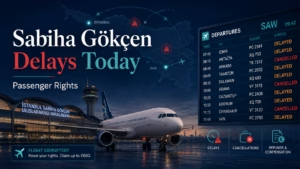
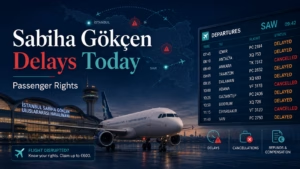
You’re standing at the gate. The departure board flips from “On Time” to “Delayed” — and then again to “Cancelled.” It happens to passengers every day.
What many travellers do not realise is that, in some cases, they may be entitled to compensation or other assistance from the airline.
In Europe, the main framework is Regulation (EC) No 261/2004, often called EU261. It can apply when a flight is heavily delayed, cancelled at short notice, or when a passenger is denied boarding against their will. The UK applies a similar regime under UK261. :contentReference[oaicite:0]{index=0}
This guide explains the basics: which flights may be covered, how compensation bands work, when airlines may refuse compensation, and what steps passengers can take next.
Check your flight
FlyClaimer provides general information and may connect eligible users with third-party claim partners. Eligibility depends on the route, airline, reason for disruption, and applicable rules.
Start your free eligibility checkWhat Is EU261?
EU261 is an EU passenger-rights regulation that sets rules on compensation and assistance in cases of denied boarding, cancellation, and long delay. It has applied since 2005. :contentReference[oaicite:1]{index=1}
In broad terms, it covers:
- certain delayed flights,
- certain cancelled flights, and
- denied boarding, including overbooking situations.
Importantly, the rules do not mean compensation is automatic in every disruption. Whether a passenger qualifies depends on the route, the operating airline, the length of the delay at arrival, and the reason for the disruption. :contentReference[oaicite:2]{index=2}
Which Flights May Be Covered?
EU261 generally applies in these situations:
- Flights departing from an EU airport, regardless of the airline, and
- flights arriving in the EU from outside the EU when the operating airline is an EU carrier.
For UK-related routes, similar rules apply under UK261. :contentReference[oaicite:3]{index=3}
Examples:
- A flight from Paris to New York may be covered, regardless of airline.
- A flight from New York to Paris may be covered if the operating airline is an EU carrier.
- A flight from Dubai to London on a non-EU, non-UK airline would usually not fall under EU261.
When Might Compensation Apply?
A passenger may be eligible for compensation in cases such as:
- long delay — usually when the passenger arrives at the final destination at least 3 hours late,
- cancellation — often where the airline gave less than 14 days’ notice, or
- denied boarding — for example, because of overbooking.
Missed connections can also qualify in some cases, especially where the flights were part of the same booking and the final arrival delay meets the threshold. :contentReference[oaicite:4]{index=4}
How Much Compensation Can There Be?
Under EU261, compensation is generally based on flight distance rather than ticket price. The standard bands are:
| Flight distance | Typical compensation band |
|---|---|
| Up to 1,500 km | €250 |
| 1,500 to 3,500 km | €400 |
| Over 3,500 km | €600 |
For long delays, compensation may apply where the arrival delay reaches 3 hours or more. In some rerouting situations, the amount can be reduced by 50% if the replacement flight arrives within certain time limits. :contentReference[oaicite:5]{index=5}
These amounts apply per passenger, not per booking. :contentReference[oaicite:6]{index=6}
The 3 Main Disruption Types
1. Flight Delays
A delay may qualify when the passenger reaches the final destination at least 3 hours late and the disruption was not caused by extraordinary circumstances. :contentReference[oaicite:7]{index=7}
2. Flight Cancellations
A cancellation may qualify for compensation when the passenger was informed less than 14 days before departure, unless the airline can rely on an exception or offers an alternative that falls within the legal limits. :contentReference[oaicite:8]{index=8}
3. Denied Boarding
If a passenger is denied boarding involuntarily, compensation rights are often stronger, especially in overbooking cases. :contentReference[oaicite:9]{index=9}
What Are Extraordinary Circumstances?
Airlines do not usually have to pay compensation when the disruption was caused by extraordinary circumstances that could not have been avoided even if all reasonable measures had been taken. :contentReference[oaicite:10]{index=10}
Examples often include:
- severe weather,
- security risks,
- political instability, or
- air traffic management restrictions.
Passengers should be cautious, though: airlines sometimes reject claims by citing “extraordinary circumstances” too broadly. Whether that defence is valid depends on the facts of the disruption.
Think your flight may qualify?
FlyClaimer can help you check the basics and may connect eligible users with third-party claim partners.
Check your flightYour Additional Rights During Disruption
Even where compensation is disputed, passengers may still have a right to care and assistance during long disruptions. Depending on the situation, this can include:
- meals and refreshments,
- hotel accommodation where necessary,
- transport between the airport and hotel, and
- communication assistance.
On very long delays, passengers may also have a right to reimbursement instead of travelling. :contentReference[oaicite:11]{index=11}
How to Start a Claim
- Check whether the route may be covered.
- Keep your documents. Save your booking confirmation, boarding pass, and any disruption messages from the airline.
- Confirm the actual arrival delay. For delay claims, arrival time at the final destination is often what matters most.
- Submit a claim to the airline. Airlines usually have a claims form or customer-service process. :contentReference[oaicite:12]{index=12}
- Escalate if needed. If the airline rejects the claim, passengers may be able to use an ADR body, a national enforcement body, or court procedures depending on the country. :contentReference[oaicite:13]{index=13}
Final Thoughts
Flight compensation rules can be valuable, but they are not automatic and they do not apply in every disruption. The strongest claims usually depend on four things: the route, the operating airline, the arrival delay, and the real reason for the disruption.
That is why it helps to start with a careful eligibility check rather than assuming every delay leads to compensation.
Was your flight disrupted?
Check your options in minutes. FlyClaimer provides general information and may connect eligible users with third-party claim partners.
Start your free eligibility checkLast updated: March 2026. This article is for general informational purposes only and does not constitute legal advice.