
How Long Does an EC261 Claim Take? A Realistic Timeline
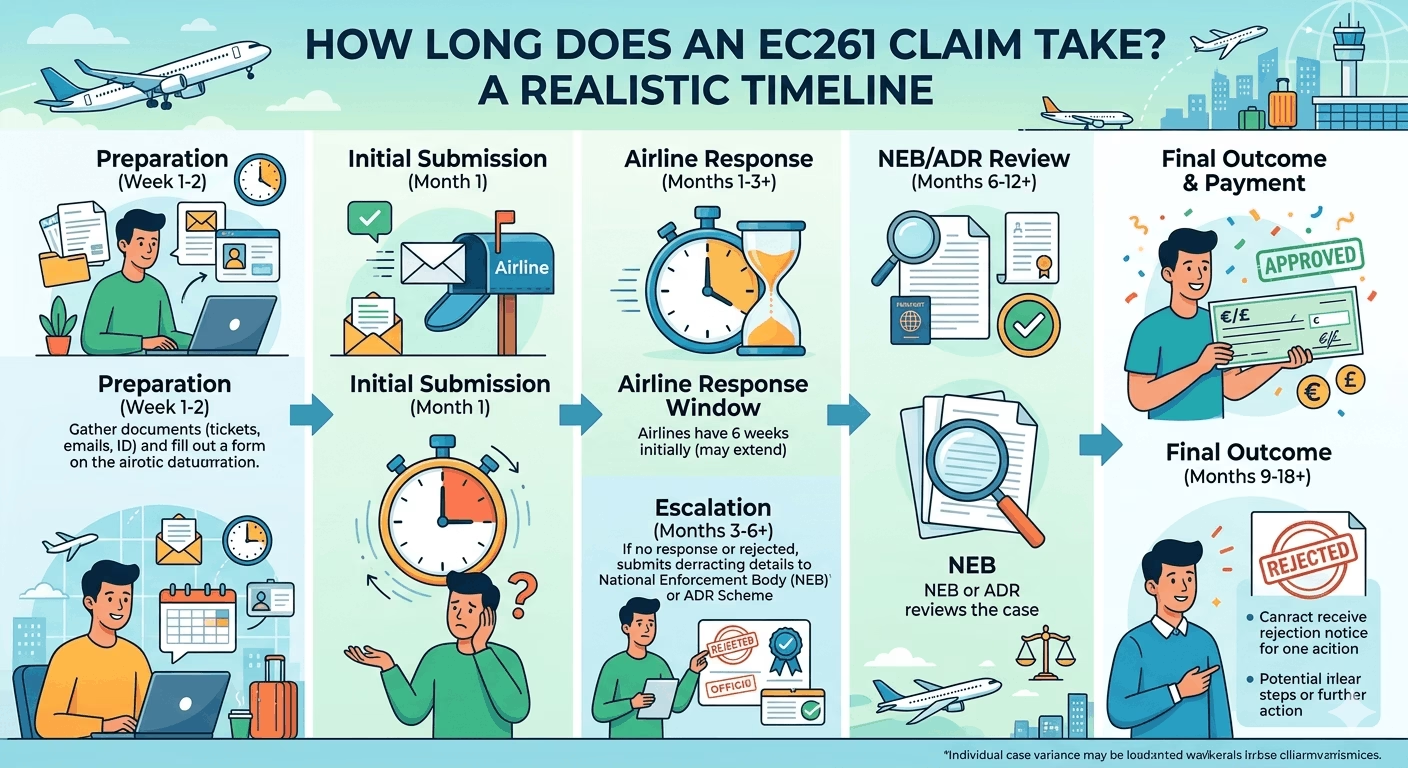
It is one of the first questions passengers ask after a delayed or cancelled flight: ‘How long is this going to take?’ The honest answer is — it depends. A clear-cut claim submitted with good documentation to a cooperative airline can be resolved in under three weeks. A disputed claim against a resistant carrier can stretch to over a year.
This guide breaks down the realistic timeline for every stage of the EC261 process, by claim route and by airline, so you know exactly what to expect.
| Quick answerA direct EC261 claim with no complications typically takes 10–20 business days. If the airline rejects your claim and you escalate to ADR or court, expect 3–12 months. Using a no-win no-fee claims service usually shortens the total timeline to 4–8 weeks for most claims. |
Stage 1: Submitting your claim (Day 0–1)
The process begins the moment you submit your claim — either directly to the airline or through a claims service. At this stage you need:
- Your booking reference (PNR)
- Boarding pass or ticket confirmation
- Evidence of the actual arrival time (FlightAware, FlightRadar24 screenshots)
- Brief description of what happened
Submitting with complete documentation from the start is the single biggest factor in reducing your total claim time. Incomplete submissions generate back-and-forth correspondence that can add weeks.
Stage 2: The airline’s initial response
| Airline | Initial response time | Rejection rate |
| Ryanair | 7–14 business days | Medium — frequently rejects first claims |
| easyJet | 10–20 business days | Medium — improving since 2023 |
| British Airways | 10–20 business days | Medium-low — higher acceptance rate |
| Wizz Air | 10–28 business days | High — one of the slowest payers |
| Jet2 | 7–14 business days | Low — generally cooperative |
| TUI | 14–28 business days | Medium — slower in peak season |
| Vueling | 14–21 business days | Medium |
| Turkish Airlines | 21–45 business days | High — escalation often needed |
Under EC261, airlines are not given a specific statutory deadline to respond — but they are expected to act within a reasonable time. The 7-day payment deadline applies only once a valid claim is accepted.
| ImportantAirlines have 7 days to pay once they have accepted your claim. If they accept but then delay payment beyond this, you can report them to your national enforcement body (CAA in the UK) and potentially add interest charges if you escalate to court. |
Stage 3: If your claim is rejected
A rejection is not the end of the road — it is often just the beginning of a longer process. Around 40–60% of valid EC261 claims are rejected on first submission, particularly against budget carriers. Here is what happens next:
Option A: Resubmit with additional evidence (2–4 weeks extra)
Many first-time rejections come from insufficient evidence or a template extraordinary circumstances response. Resubmitting with the actual flight data (FlightAware, Eurocontrol CODA statistics), the specific regulation text, and a formal complaint letter can overturn a rejection without needing third-party involvement.
Option B: Alternative Dispute Resolution — ADR (3–9 months)
UK passengers can use approved ADR schemes such as Aviation ADR or CEDR. These are free for passengers, legally binding on the airline, and remove you from direct conflict with the carrier. The downside is time — most ADR cases take between 3 and 9 months to conclude.
Option C: National Enforcement Body — CAA/NEB (6–18 months)
The UK Civil Aviation Authority (CAA) and EU national enforcement bodies have the power to investigate systemic non-compliance by airlines. They are most effective for passengers in mass-cancellation events where thousands of people were affected. Individual cases can take 12–18 months and the outcome is sometimes a recommendation rather than a direct payment order.
Option D: Small claims court (3–6 months)
This is often the most effective escalation route, particularly in England and Wales. Filing against an airline in the county court costs £35–£70 and airlines frequently settle before the hearing date rather than incur legal costs. The total timeline from filing to payment is typically 3–6 months.
Option E: Use a claims management company (4–8 weeks for standard claims)
A specialist claims service like FlyClaimer manages the full process — submission, correspondence, rejection response, and legal escalation if needed. Because claims companies send formal letters before action early in the process and have established legal relationships with airlines, standard cases often resolve faster than self-managed claims. You pay nothing upfront; the service fee is deducted from the compensation on success.
Full timeline comparison by route
| Route | Typical timeline | Cost to passenger |
| Direct claim — accepted | 10–20 business days | No extra cost |
| Direct — rejected and resubmitted | 4–10 weeks total | No extra cost |
| Claims service (clean claim) | 4–8 weeks | 25–35% fee + VAT from payout |
| Claims service + rejection | 8–16 weeks | 25–35% fee + VAT from payout |
| ADR (Aviation ADR or CEDR) | 3–9 months | Free to passenger |
| NEB / CAA investigation | 6–18 months | Free to passenger |
| Small claims court | 3–6 months | £35–£70 filing fee (usually recovered) |
Factors that lengthen your claim
1. Incomplete initial submission
Missing documentation is the single most common reason claims drag on. The airline asks for more information, you respond, they process it, and two to three weeks disappear. Sending everything at once removes this bottleneck.
2. Extraordinary circumstances disputes
If the airline claims extraordinary circumstances — weather, ATC, security — and you want to challenge this, you need evidence. Obtaining flight data from Eurocontrol, weather METAR reports, or other flight records takes time and expertise.
3. Claiming for older flights
Claims more than 12–18 months old often require additional correspondence to verify historical flight data. The claim is still valid, but expect a slightly longer processing time. Airlines also sometimes dispute the jurisdiction for older claims.
4. Group claims or multiple passengers
A claim for a family of five or a large group technically involves multiple individual claims linked to the same booking. Some airlines process these together smoothly; others treat each passenger separately, creating extra administration.
5. Choosing the wrong escalation channel
Going to the CAA before trying ADR, or going to ADR before writing a formal letter before action to the airline, can add months to your timeline. The correct escalation sequence is: airline complaint → formal LBA → ADR/small claims.
What does the EC261 legal framework say about payment deadlines?
EC261 does not specify a response deadline for airlines — only that once compensation is due, it must be paid. The regulation requires airlines to inform passengers of their rights at the time of disruption, and the European Court of Justice has confirmed that airlines cannot use internal processing backlogs as a justification for non-payment.
In practice, UK courts and the CAA use a ‘reasonable time’ standard. Consistently in legal proceedings, 28 days from formal demand has been treated as the threshold for unreasonable delay.
How to speed up your EC261 claim
- Submit with full documentation the first time — boarding pass, booking confirmation, arrival time proof
- Send your claim via trackable means (email is fine; keep a copy with timestamp)
- If no response in 14 business days, send a formal follow-up referencing EC261 Article 7 and your right to statutory compensation
- After 28 days with no resolution, send a Letter Before Action (LBA) giving the airline 14 days to pay before you escalate
- Use a claims service for complex cases or situations where the airline has already rejected once
- File in small claims court rather than waiting for ADR if the airline is known to be unresponsive
Which airlines pay fastest?
Based on industry data and passenger reports, airlines broadly fall into three tiers for claim processing speed:
Faster payers
- Jet2 — strong customer service culture, generally pays within 2 weeks for valid claims
- British Airways — higher administrative overhead but good acceptance rate
- Lufthansa — efficient process for straightforward claims
Average payers
- easyJet — improved significantly since 2022 enforcement action
- Ryanair — slower first-time response but responds to escalation
- Air France — reasonable but requires formal complaint format
Slower payers — escalation often needed
- Wizz Air — consistently rated lowest for claim satisfaction, often requires court or ADR
- Turkish Airlines — long initial response times for UK passengers
- LOT Polish Airlines — claims often stall at initial stage
FAQ
How long does Ryanair take to pay EC261 compensation?
Ryanair's initial response typically arrives within 7–14 business days. If accepted, payment follows within 7 days. If rejected (which is common), resubmission or escalation adds 4–16 weeks depending on the route you take. Using a claims service with a formal letter before action process typically resolves Ryanair claims within 6–10 weeks total.
Is there a deadline for claiming EC261 compensation?
Yes . You have 6 years in England and Wales, 5 years in Scotland, and 3 years in most EU countries from the date of the disrupted flight. The clock starts from the original scheduled departure date, not from when you first attempted to claim.
Can I claim for a flight that was disrupted 2 or 3 years ago?
Yes. Claims from 2022, 2021, and earlier are still regularly processed and paid. The limitation period has not expired. The process is identical to a recent claim — you just need to provide flight records for the historical date, which can be obtained from FlightAware or directly from the airline.
What happens if the airline simply stops responding?
Silence is not acceptance, but it can support your escalation. Document all your communication attempts with dates and content. After 28 days of no substantive response, you have strong grounds to proceed directly to small claims court or ADR without further correspondence required.