
Flight Delay Checklist: 5 Things to Do at the Gate to Win Your Claim
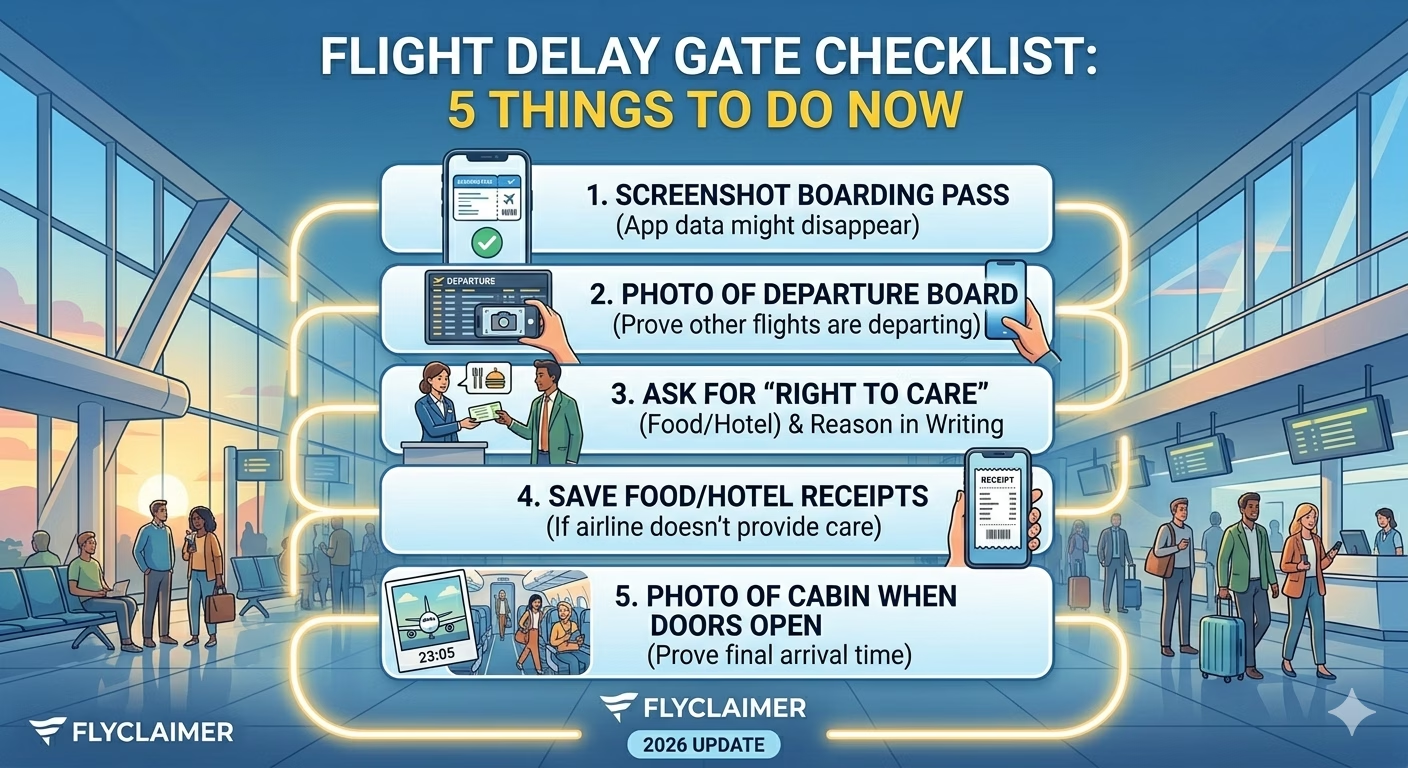
Claims are won and lost before passengers ever leave the airport. The difference between a successful €400 compensation payout and a frustrating rejection often comes down to a single photograph, a receipt, or a conversation with a gate agent that should have happened at 14:00 but didn’t because the passenger was distracted or didn’t know it mattered.
If success in a flight disruption claim is 10% law and 90% evidence, then everything that happens between the departure board turning red and the moment your plane finally takes off is the most important part of the process. For a full overview of the rights that underpin your claim, see 2026 EU Air Passenger Rights: New Rules for Flight Compensation. This guide gives you the practical checklist for everything you should do at the gate — in order.
Step 1: The Boarding Pass Rule
The single most important physical document in any flight compensation claim is your boarding pass. It proves three things simultaneously: that you were booked on the flight, that you checked in successfully, and that you were present and ready to travel. Without it, everything else is harder.
The most common mistake passengers make is throwing away the boarding pass once they land — or in the chaos of a long delay and a late arrival, simply forgetting it. The solution is to treat the boarding pass as a legal document from the moment you receive it until at least 60 days after the disruption is resolved.
A digital screenshot is actually preferable to a physical boarding pass in most cases. Take a screenshot of your mobile boarding pass the moment you check in, save it to your camera roll, and then take a second screenshot of the boarding pass screen while you are at the airport during the disruption. The metadata of that second screenshot will show the exact time and location it was taken, which can be useful additional evidence.
If you have a physical boarding pass, photograph both sides and email the photographs to yourself immediately. This creates a timestamped email that serves as an independent copy. If the physical pass is lost later, the email record remains.
| What If You Lose Your Boarding Pass?Contact the airline and request a copy of your booking record and check-in confirmation. Under GDPR, EU-registered airlines must provide your personal data — including booking records — upon request. This data package will typically include your check-in time, seat assignment, and boarding confirmation, which together serve a similar function to the boarding pass itself. |
Step 2: The Departure Board Photography Protocol
The single most powerful piece of independent evidence in a delay claim is a photograph of the departures board showing your flight, the current time, and the updated status — taken multiple times during the disruption. Airlines sometimes dispute delay durations, and when they do, it becomes your word against their data. Multiple timestamped photographs of the departures board eliminate that dispute.
The protocol is straightforward. As soon as the departure board shows any delay to your flight — even a minor initial delay — photograph it. Photograph it again every hour. Photograph it a final time showing the revised departure time closest to your actual boarding, and again when the gate opens. Make sure the full board is in frame so that your specific flight, the original scheduled time, and the updated time are all visible simultaneously.
Why hourly? Because the final arrival delay — which determines compensation eligibility — is what matters, not the departure delay. A flight that shows a two-hour departure delay but makes up 30 minutes in the air arrives 90 minutes late and does not qualify for compensation. A flight that keeps accumulating small delays that add up to three hours at destination does qualify. Hourly photographs document the accumulation pattern.
Most modern smartphones embed GPS coordinates and exact timestamps into photograph metadata. Do not edit, filter, or process these photographs before submitting them as evidence — doing so may strip the metadata. Share the original files.
Step 3: Food and Drink Receipts — Getting Reimbursed
EC 261/2004’s right to care includes meals and refreshments proportionate to the waiting time. This right kicks in at two hours for short-haul, three hours for medium-haul, and four hours for long-haul. The right exists whether or not the airline issues a voucher. For a full breakdown of what you are entitled to and when, see our main guide to 2026 EU Air Passenger Rights. If no voucher is provided, you purchase food and drink at your own expense and claim reimbursement afterward.
For this reimbursement to succeed, you need receipts. Not just memories of what you spent — physical or digital receipts with the vendor name, the date and time of purchase, and the items purchased. Request a printed receipt for every transaction, including water and coffee. Take a photograph of each receipt at the airport before it gets crumpled or faded.
The standard for ‘reasonable’ expenses is important. A €15 sandwich and coffee combination for a three-hour delay is reasonable and straightforward to claim. A €90 airport restaurant meal with wine will face scrutiny. Alcohol is categorically not reimbursable.
| Timing MattersFood receipts must be from during the delay, not before your original scheduled departure or after you have boarded. A receipt timestamped three hours before your original departure time will not be accepted for delay-period reimbursement. The receipt timestamps are evidence of when you were waiting. |
Step 4: Asking for the Reason in Writing
This is the step most passengers skip because it feels confrontational. It should not feel confrontational — it is a polite, professional request that creates documentary evidence of the airline’s own stated reason for the disruption. That documentation can either support your claim or immediately reveal whether an extraordinary circumstances defence is plausible.
When you approach the gate agent or airline duty manager during a delay, say the following: ‘I would like to make a formal request. Can you please provide me with the reason for this delay in writing, including your name and the time of this conversation?’ The reason for the delay is particularly important because airlines often invoke extraordinary circumstances as a defence — and the written reason given at the gate is frequently inconsistent with the extraordinary circumstances claim submitted later.
If the agent refuses to provide anything in writing, note their name, the time of the refusal, and write it down yourself immediately afterward on your phone. ‘At 14:35, Gate 7, agent [Name] refused to provide written reason for delay.’ This record of a refusal is itself useful evidence.
A Simple Template
If you want a script: ‘My flight [flight number] scheduled to depart at [time] appears to be significantly delayed. Under EC 261/2004, I am entitled to information about the reason for the delay. Can you provide this in writing, along with your name and the current time?’
Step 5: The PIR Form — Your Weapon for Luggage Claims
If your disruption involves missing, damaged, or delayed checked luggage, the Property Irregularity Report (PIR) is the single most important document you need to obtain before leaving the airport.
A PIR is a formal record of a baggage claim filed with the airline or its ground handling agent at the destination airport. It is filed at the baggage desk in the arrivals hall, not at the departure airport. The PIR contains a unique reference number that allows tracking of your claim. Most airlines require a PIR to be filed within seven days for delayed or damaged baggage.
If you leave the arrivals hall without filing a PIR, recovering compensation for lost or damaged luggage becomes dramatically harder. The airline will argue that you had the opportunity to report the issue and did not, and some may refuse to acknowledge the claim at all.
Bonus Step: Document Everything That Goes Wrong
Beyond the five core steps, two additional pieces of documentation can significantly strengthen a complex claim. First, if you incurred consequential losses due to the delay — a missed hotel booking, a non-refundable event ticket, transport costs to reach your final destination when your connection was missed — document all of these with receipts and booking confirmations.
Second, if you observe other passengers in the same situation receiving different treatment — for example, some passengers being offered accommodation and others not — note this. Inconsistent treatment by airlines can be relevant in enforcement proceedings.
If you were delayed at Tirana International Airport, additional local context matters — including where to find airline representatives and which airside facilities are available. Our guide to Mother Teresa Airport (TIA) delays covers all of this in detail.
And if you are flying with Wizz Air or Ryanair, our guide to Wizz Air & Ryanair Compensation 2026 explains the specific objections these carriers raise and how to counter each one.
Organising Your Evidence: A Simple System
Before you leave the airport — or as soon as you are airside with connectivity — take five minutes to create a dedicated folder on your phone or cloud storage labelled with your flight number and date. Move every photograph, receipt, and screenshot into that folder immediately. Send yourself an email with a brief timeline of events as you remember them, including any conversations with airline staff. This email will be timestamped and will serve as a contemporaneous account.
When you get home, back up the folder and send all key documents to an email address you can access from multiple devices. Evidence that exists only on one device is one broken phone away from being lost.
| Ready to claim your compensation?Ready to submit your evidence? Upload your documents directly to Flyclaimer and our team will build your claim from the documentation you have collected. The stronger your evidence, the faster we can get your money back.→ Start your claim NOW |
FAQ
1. Is a digital boarding pass enough evidence to file a claim in 2026?
Yes. A screenshot of your digital boarding pass (showing your ticket number and PNR) is valid evidence. However, many airline apps delete the boarding pass once the flight is marked "completed." Pro-tip: Take a screenshot the moment you check in so you don't lose access to it during the delay.
2. The airline staff refused to give me a written reason for the delay. What now?
Don't worry—this is common. If they refuse, immediately take a photo of the departure board showing your flight's delay status alongside other on-time flights. This proves the airport was operational, making it harder for the airline to claim "weather" or "airport issues" later.
3. If I use a meal voucher from the airline, do I lose my right to cash compensation?
No. Accepting "Right to Care" (vouchers for food, drinks, or hotels) is a separate legal obligation. It does not waive your right to the €250–€600 compensation penalty. Just be careful not to sign any document that explicitly states you are "waiving your EC 261 rights" in exchange for the voucher.
4. How do I prove the final arrival time if the airline disputes it?
In 2026, delay is calculated by when the aircraft doors open at the destination. If your delay is right on the 3-hour edge, take a photo of the cabin from your seat with a time-stamp app visible the moment the doors open. This "Positioning Data" is much harder for airlines to argue against than their own internal logs.
5. What is a PIR form and do I need it for a standard flight delay?
PIR stands for Property Irregularity Report. You only need this if your luggage was also delayed, lost, or damaged. You must file it at the baggage desk before leaving the arrivals hall. For a standard flight delay (money for your time), your boarding pass and departure board photos are your primary weapons.