
Extraordinary Circumstances: When Airlines Must Pay (and When Not)
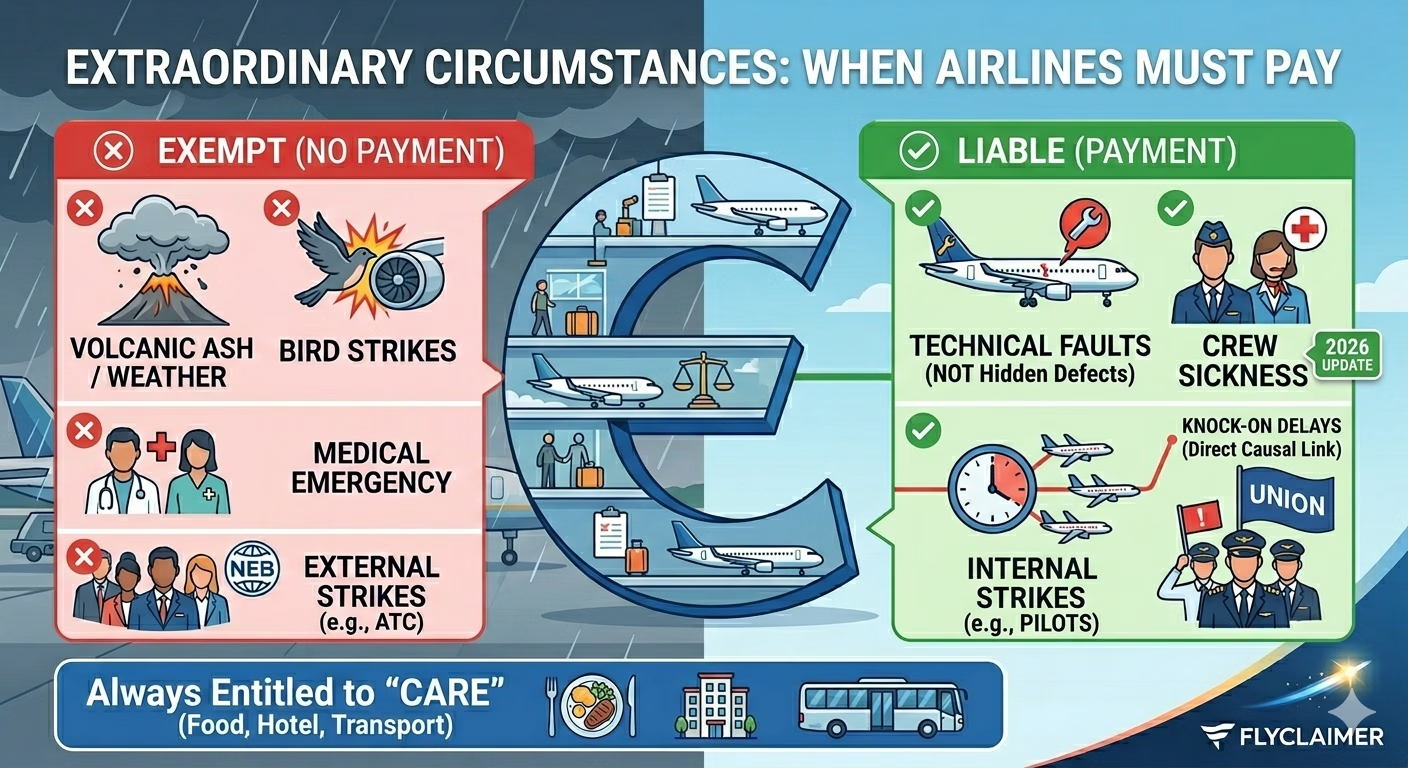
Three words stand between millions of passengers and the compensation they are owed. ‘Extraordinary circumstances.’ Airlines invoke this phrase more than any other defence in flight disruption claims, and they invoke it broadly — for mechanical failures, crew shortages, minor weather events, and situations that courts have ruled time and again do not qualify.
The term sounds legally imposing, but its actual definition has been steadily narrowed by the European Court of Justice and national courts over the past decade. In 2026, a significant General Court judgment further tightened what airlines can legitimately claim. This guide explains exactly what extraordinary circumstances means in law, what it does not mean, and how to respond. For the full picture of your rights framework, start with 2026 EU Air Passenger Rights: New Rules for Flight Compensation.
What the Law Actually Says
EC 261/2004 provides that airlines are not required to pay compensation if they can prove that the cancellation or delay was caused by extraordinary circumstances which could not have been avoided even if all reasonable measures had been taken. This contains two distinct requirements that both must be met:
- First: the circumstance must be extraordinary — meaning it is by nature or origin not inherent in the normal exercise of the airline’s activity, and is outside the airline’s actual control.
- Second: the circumstance must have been unavoidable — meaning the airline took all reasonable measures to prevent the disruption and still could not avoid it.
Both elements are required. An airline cannot simply demonstrate that something unusual happened; it must also show that it did everything reasonably possible to prevent the delay.
The January 2026 General Court Judgment: ATM Decisions
The most significant legal development for extraordinary circumstances in 2026 came in a January General Court judgment addressing the question of Air Traffic Management restrictions. The case arose from multiple consolidated claims against several European carriers for delays caused by ATC capacity restrictions — a common type of disruption where ground delay programmes are imposed by EUROCONTROL or national air traffic control authorities.
Airlines had long argued that ATC restrictions — because they come from an external authority and cannot be overridden by the carrier — automatically constitute extraordinary circumstances. The General Court’s 2026 ruling rejected this broad interpretation. The court found that while the ATC restriction itself may be extraordinary, the airline’s reaction to that restriction must still meet the ‘all reasonable measures’ test.
Carriers who build schedules without meaningful buffer time in congested airspace, and who have no contingency protocols for common types of ATC restrictions, fail the ‘all reasonable measures’ test even when the restriction itself might qualify as extraordinary.
| What This Means For YouIf your flight was delayed due to ‘ATC restrictions’ and the route is one that routinely experiences such delays (London Heathrow approaches, Frankfurt ground delays, Rome Fiumicino congestion), the airline’s extraordinary circumstances claim is now significantly weaker than it was before the January 2026 ruling. |
Staff Sickness Is Not Extraordinary
One of the most commonly abused extraordinary circumstances claims involves crew illness. Airlines frequently cite ‘unexpected crew sickness’ or ‘unavailability of operating crew’ as the reason for a delay or cancellation, and then invoke extraordinary circumstances on the basis that they could not have foreseen a particular crew member falling ill.
The European Court of Justice ruled definitively in Wallentin-Hermann v Alitalia that technical problems and operational staffing issues that are inherent in the normal exercise of airline activity cannot be classified as extraordinary. Crew illness has been consistently held to fall within this principle by national courts across Europe.
Running schedules with no redundancy — no standby crew available at short notice — is an operational choice, not a response to an extraordinary event. When a first officer calls in sick and there is no standby crew available, the disruption arises from the airline’s own resource planning decisions. In 2026, courts in Germany, the Netherlands, and the UK have all upheld this principle in claims where airlines cited crew unavailability as extraordinary.
This defence is frequently used by low-cost carriers. For specific guidance on how Wizz Air and Ryanair deploy this and other excuses, and how to counter them, see Wizz Air & Ryanair Compensation 2026.
Technical Faults: The Highest-Abuse Category
Technical faults generate the largest volume of disputed extraordinary circumstances claims. Hidden manufacturing defects — problems that genuinely could not have been detected by reasonable maintenance and inspection — may qualify as extraordinary. All other technical faults — failed actuators, hydraulic leaks, avionics failures, bird strikes, and the overwhelming majority of aircraft mechanical events — are considered inherent operational risks.
| The Maintenance Record TestIf an airline claims a technical fault was extraordinary, you are entitled to request the maintenance records for the aircraft involved around the time of the disruption. A fault that was already noted in prior inspections, deferred, or that appeared on a recurring basis in ACARS data is clearly not extraordinary. |
Weather: When It Is the Airline’s Fault
Weather is the most intuitively sympathetic extraordinary circumstances claim. Genuine extraordinary weather events include severe thunderstorm systems causing widespread airport closure, heavy snow requiring extended runway de-icing that exceeds all reasonable planning assumptions, and volcanic ash clouds requiring airspace closure.
What does not qualify is weather that was forecast and foreseeable, where the airline took no proactive steps. A winter fog event at Frankfurt or a summer thunderstorm pattern over southern Europe is neither sudden nor unforeseeable. An airline that builds tight turnaround schedules with no buffer for typical seasonal weather patterns, and whose aircraft then gets caught in a weather delay that was forecast 12 hours earlier, has a much weaker extraordinary circumstances case than one that attempted proactive rescheduling or diversion planning.
The 2026 Burden of Proof Shift
The 2026 EU Air Code reforms alter the procedural dynamic. Airlines must now provide documented evidence of the extraordinary circumstance as part of their initial claim response — the same 48-hour window that applies to the standardised claim form. A response that simply states ‘the disruption was caused by extraordinary circumstances outside our control’ without supporting evidence is no longer a legally adequate claim denial.
The documentation must include the specific nature of the extraordinary event, evidence that the event actually occurred (ATC logs, meteorological reports, technical incident reports), and an explanation of what reasonable measures the airline took and why those measures were still insufficient to prevent the delay.
How to Challenge an Extraordinary Circumstances Rejection
If your claim is rejected on extraordinary circumstances grounds, the response you receive must now include the specific documented basis for that claim. If it does not, the rejection itself is non-compliant. Your challenge process:
- Request the full incident report and the specific documentation the airline is relying on to claim the circumstance was extraordinary.
- Cross-reference the disruption with public ATC logs, airport operational data, and meteorological records for the date and airport in question. Many of these are publicly available.
- If the airline claims a technical fault, request the aircraft maintenance record for the 72-hour period surrounding the disruption.
- File with the National Enforcement Body in the country of the airline’s registration or the departure airport. Include your evidence and the airline’s documented response.
Before filing any challenge, make sure your own documentation is complete. A well-organised evidence file — boarding passes, departure board photos, written reason from gate agents — is the foundation of any successful dispute. Our flight delay evidence checklist walks through every document you need, step by step.
| Related: Flight Delay Checklist: 5 Things to Do at the Gate to Win Your Claim → |
| Ready to claim your compensation?Did the airline tell you that your disruption was caused by extraordinary circumstances? Our legal team reviews these claims every day and knows exactly what evidence is required to challenge them. Let Flyclaimer double-check that rejection.→ Start your claim NOW! |
FAQ
1. The airline says my delay was due to "Operational Reasons"—is that an extraordinary circumstance?
No. "Operational Reasons" is a broad term airlines often use to hide avoidable issues like late crew arrivals, slow aircraft cleaning, or scheduling conflicts. In 2026, these are considered "inherent" to the business of running an airline. If you see this on the departure board, you are almost certainly entitled to compensation.
2. Can I claim compensation if the pilot or crew falls ill?
Yes. Following landmark court rulings (like the Lipton case), crew sickness is officially considered a risk that airlines must manage through contingency planning. In 2026, if a flight is delayed because a pilot or cabin crew member called in sick and no standby was available, the airline is liable for compensation.
3. Does "Bad Weather" always mean I lose my right to a payout?
Not necessarily. For weather to be "extraordinary," it must be incompatible with the safe operation of the flight (e.g., a volcanic ash cloud or a freak storm). If your flight is cancelled due to "heavy rain" but other airlines are taking off from the same airport at the same time, the airline may be using weather as an excuse for an underlying technical or staffing issue.
4. If an Air Traffic Control (ATC) strike causes the delay, can I still get a refund?
While an external strike (like ATC or airport security) is an extraordinary circumstance that usually voids the €250–€600 compensation, it never voids your right to a refund. If your flight is cancelled or delayed by over 5 hours due to an ATC strike, you can still choose to cancel your trip and get a 100% cash refund.
5. What if the "Extraordinary Circumstance" happened to a previous flight?
Airlines often try to use "knock-on effects" (e.g., "the plane was late from its previous destination due to weather"). In 2026, the courts require a direct causal link. If the airline had a reasonable window to find a replacement aircraft or adjust the schedule but failed to do so, the "extraordinary" status of the earlier event does not apply to your flight.