
2026 EU Air Passenger Rights: New Rules for Flight Compensation
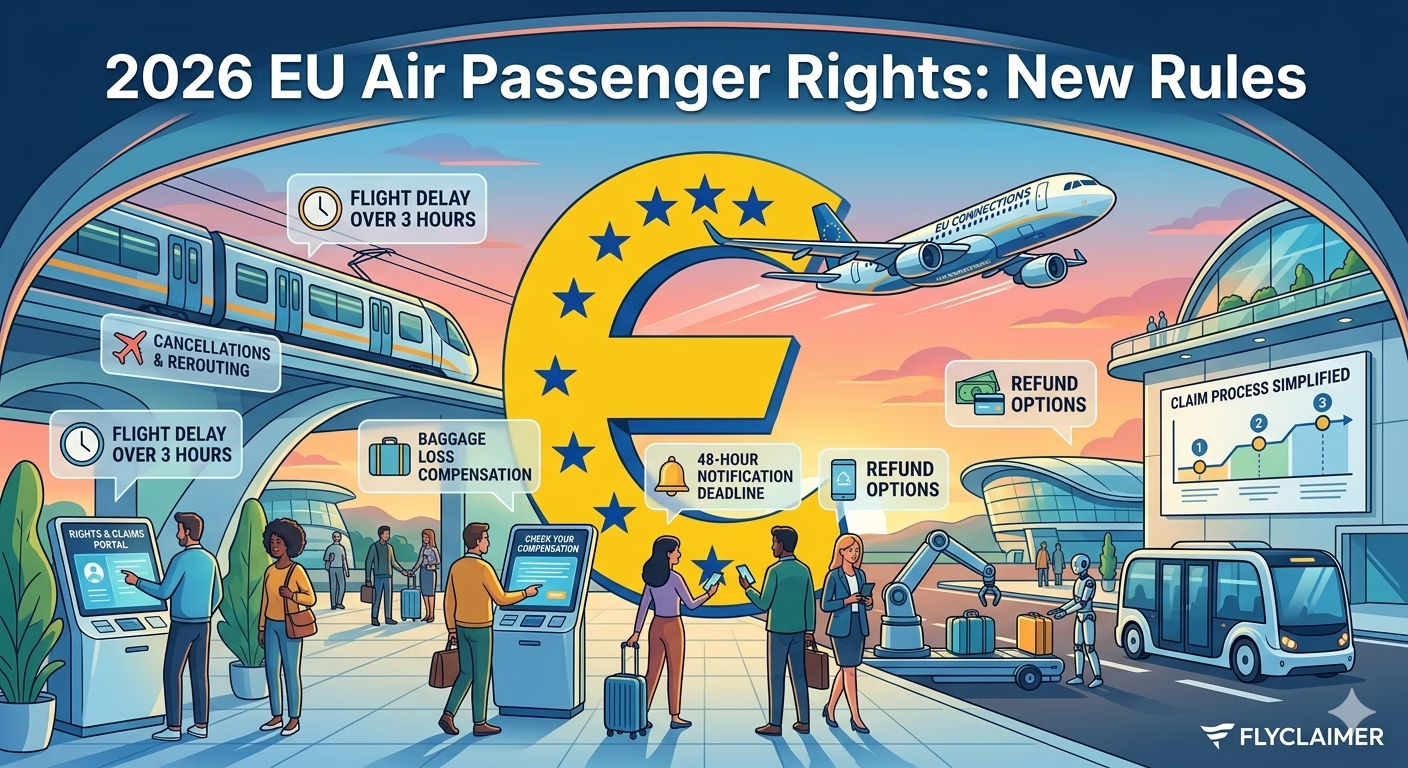
If you have ever stood at a departure gate watching the clock tick past three hours, you probably already know the magic number: €600. Under EC 261/2004, European passengers have enjoyed some of the strongest flight compensation rights in the world for over two decades. But 2026 marks a turning point. New European Council agreements and a wave of court rulings are reshaping exactly when, how, and how much you can claim.
This guide explains everything you need to know about your 2026 EU air passenger rights — from the hotly debated new delay thresholds to mandatory claim forms, the tightened one-year deadline, and brand-new luggage rules that most passengers have not yet heard about.
Background: What EC 261/2004 Has Always Given You
The landmark regulation EC 261/2004 established a uniform framework for passenger compensation across EU member states. It covers three main scenarios: flight delays of three or more hours upon arrival at your destination, flight cancellations without sufficient advance notice, and denied boarding due to overbooking. It applies to all flights departing from an EU airport, and all flights arriving at an EU airport on an EU-based carrier.
The ‘Sturgeon’ ruling from the European Court of Justice in 2009 was arguably the most important expansion of these rights: it confirmed that delayed passengers — not just cancelled ones — could claim compensation, provided the delay caused them to arrive at least three hours late. That three-hour rule has been the cornerstone of flight compensation ever since.
| Key PrincipleThe EC 261/2004 regulation applies regardless of your ticket price. A €9 Wizz Air fare carries the exact same legal weight as a €900 business class ticket. |
| Related: Wizz Air & Ryanair Compensation 2026: Get Your Refund & Claim → |
The Threshold Debate: 3 Hours, 4 Hours, or 6 Hours?
The biggest change on the horizon for 2026 — and the most controversial — is the proposed reform to delay thresholds for long-haul flights. Under the current Sturgeon framework, the three-hour rule applies universally regardless of how far you are flying. Critics, particularly the large European carriers, have long argued that this places an unreasonable burden on ultra-long-haul operations where minor delays are operationally harder to avoid.
The 2026 European Council proposals introduce a tiered threshold system:
- Short-haul flights (under 1,500 km): the three-hour rule remains unchanged.
- Medium-haul flights (1,500–3,500 km): three hours continues to apply.
- Long-haul flights (over 3,500 km from an EU airport): a four-hour threshold would apply for a reduced €300 compensation, with the full €600 triggered at six hours or more.
- Non-EU operated long-haul arriving into the EU: a four-hour threshold is proposed under the new EU Air Code framework.
It is critical to understand that as of early 2026, these proposals are still moving through the legislative process. Until formally adopted and published in the Official Journal of the EU, the original Sturgeon three-hour rule remains binding law. Airlines that attempt to invoke the new thresholds prematurely to deny claims are acting unlawfully.
| ImportantIf an airline tells you your long-haul claim is invalid because ‘the rules changed in 2026,’ ask them to cite the specific Official Journal publication reference. Most cannot, because full adoption has not yet occurred for all elements of the reform. |
Mandatory Standardized Claim Forms: A New Obligation for Airlines
One of the most passenger-friendly changes confirmed for 2026 is the requirement for standardized claim documentation. Previously, each airline could set its own claim submission process — resulting in wildly inconsistent experiences. Ryanair’s process looked nothing like British Airways’, which looked nothing like Lufthansa’s.
Under the 2026 obligations, airlines operating EU-regulated routes must now provide passengers with a standardized claim form within 48 hours of a disruption. This form must include:
- A clear description of the disruption event and its cause as recorded by the airline.
- The scheduled and actual arrival times, certified by the carrier.
- The distance of the route in kilometres (to determine which compensation band applies).
- A reference number for your specific disruption, traceable in internal systems.
- Contact details for the airline’s designated complaints handler and the relevant National Enforcement Body.
This is a significant shift in the burden of information. Airlines can no longer simply ignore passengers or send vague responses citing ‘operational issues.’ The 48-hour window creates a trackable, enforceable obligation. If the airline fails to provide the form within 48 hours, note the date and time — this failure itself may strengthen your claim position.
The 2026 One-Year Deadline: Act Faster Than You Used To
Historically, the statute of limitations for flight compensation claims varied significantly by country. In the UK, passengers had six years. In Germany, three years. In France, five years. This patchwork created enormous confusion.
The 2026 EU Air Code reform is moving toward a harmonized one-year limitation period for filing flight compensation claims across the EU. The clock starts from the date of the disruption, not from when you first became aware of your rights.
This is not a reason to panic about older claims — existing national limitation periods continue to apply to disruptions that occurred before the reform’s adoption date. But for any disruption happening in 2026 and beyond, you should treat one year as your working deadline and aim to file well within that window.
The practical advice is simple: do not wait. If your flight was disrupted, start your claim within weeks, not years. For a step-by-step guide on what to collect immediately, see our flight delay evidence checklist — acting on it at the airport is far easier than reconstructing evidence months later.
Free Cabin Luggage Rights: The 2026 Mandate Airlines Hate
Perhaps the most commercially disruptive element of the 2026 reforms for low-cost carriers is the new standardized cabin baggage entitlement. For years, budget airlines monetized carry-on luggage through fees that could often exceed the base fare itself. Ryanair, Wizz Air, and easyJet all built significant ancillary revenue streams around this model.
The 2026 EU Air Code mandates that all passengers must be entitled, at no additional cost:
- One personal item (handbag, laptop bag, or small backpack) that fits under the seat in front, with minimum dimensions of 40 x 30 x 20 cm.
- One small trolley-style cabin bag with minimum dimensions of 55 x 40 x 20 cm placed in the overhead locker.
These are minimum entitlements. Airlines may offer larger allowances, but they cannot charge for bags that fall within these standardized dimensions. This applies to all tickets, including the cheapest base fares. For a full breakdown of how Wizz Air and Ryanair handle these rules in practice, see Wizz Air & Ryanair Compensation 2026.
Your 2026 Compensation Table
| Distance | Delay Threshold | Compensation |
| Up to 1,500 km | 3+ hours | €250 |
| 1,500–3,500 km | 3+ hours | €400 |
| Over 3,500 km (EU departure) | 3+ hours | €300* |
| Over 3,500 km (EU departure) | 4+ hours | €600 |
| Non-EU, over 3,500 km | 4+ hours (proposed) | €600 |
*Reduced to €300 if airline offers rerouting with arrival within 4 hours of scheduled time.
What Airlines Must Offer You at the Airport
Alongside compensation, EC 261/2004 — unchanged by the 2026 reforms — requires airlines to provide ‘care’ when disruptions extend beyond a certain point. This is separate from and in addition to financial compensation.
For delays of two hours or more on short-haul flights, airlines must provide meals and refreshments proportionate to the waiting time, plus two free telephone calls, emails, or faxes. For overnight delays, they must provide hotel accommodation and transport to and from the hotel. These rights apply regardless of the cause of the delay — even in extraordinary circumstances where financial compensation is not owed.
| Practical TipIf an airline representative refuses to provide care vouchers, go to the airline’s check-in desk or operations centre in the airport rather than relying on gate staff. Document every refusal in writing, including the name of the staff member if possible. |
| Related: Flight Delay Checklist: 5 Things to Do at the Gate to Win Your Claim → |
Extraordinary Circumstances: The Airline’s Escape Hatch
No guide to 2026 passenger rights would be complete without addressing the single most abused defence airlines use: extraordinary circumstances. Airlines are exempt from paying compensation if the delay or cancellation was caused by events beyond their reasonable control. The phrase sounds broad, but courts have consistently narrowed its application. For a full breakdown of what qualifies — and how to challenge a rejection — see our dedicated guide: Extraordinary Circumstances: When Airlines Must Pay (and When Not).
How to Start Your Claim in 2026
The process is straightforward. Gather your boarding pass (physical or digital screenshot), any communication from the airline about the disruption, receipts for expenses incurred, and the reference number from your booking. If you received a standardized form under the new 48-hour obligation, include that too.
You can submit directly to the airline, to your national enforcement body, or use a specialist claims service. If submitting directly, airlines have a legal obligation to respond within a defined period — and their first response is rarely their final offer.
| Ready to claim your compensation?Don’t let the new 2026 rules confuse you or let an airline use them to unfairly deny your claim. Flyclaimer checks your eligibility instantly against both the existing law and the 2026 updates, so you know exactly where you stand before filing a single form.→ Start your claim NOW |
FAQ
How long do I have to file a flight compensation claim in 2026?
Under the 2026 EU Air Code reforms, there is a move toward a harmonized one-year deadline across all EU member states. Previously, time limits varied from 2 to 6 years depending on the country. To ensure you don't lose your right to €600, it is highly recommended to submit your claim through Flyclaimer as soon as the disruption occurs.
Do airlines have to provide a claim form at the airport?
Yes. New 2026 regulations require airlines to provide passengers with a standardized claim form within 48 hours of a flight disruption. This form must include the official reason for the delay, the certified arrival time, and the distance of the flight. If the airline fails to provide this document, it can be used as evidence that they are obstructing your passenger rights.
Can Wizz Air or Ryanair charge for cabin bags in 2026?
he 2026 mandate requires all airlines to allow one personal item (under-seat) and one small trolley bag (overhead locker) at no extra cost. While low-cost carriers previously charged for the trolley bag, the new standardized dimensions (55 x 40 x 20 cm) must now be included in even the cheapest base fares.
What is the maximum compensation I can get for a delayed flight?
The maximum compensation remains €600 per passenger. The amount is determined by the distance of your flight: €250 for short-haul (under 1,500 km), €400 for medium-haul (1,500–3,500 km), and €600 for long-haul (over 3,500 km). This applies regardless of the price you paid for your ticket.